Skip to Main Content

Meet DRCY.
AI that understands your designs in context.

DRCY is AllSpice's AI agent built specifically for hardware development. Collaborate with DRCY to explore design ideas, investigate specific questions, and run comprehensive design reviews. Surface potential issues early and inspect findings directly on the design, with evidence you can trace, trust and verify.
A table displaying average yearly salaries by education level for 2019 and 2022, with increases in all categories: Bachelor's degree salaries rose from $65,172 to $70,208, Master's degree salaries from $75,416 to $85,484, Professional degrees from $101,898 to $115,384, and Doctoral degrees from $84,396 to $94,124.
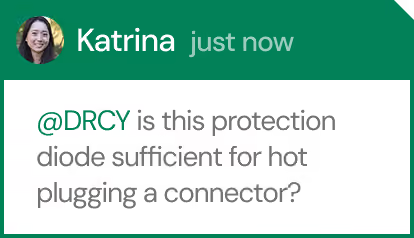
A message from Katrina with a profile picture of a smiling woman with long dark hair, asking '@DRCY is this protection diode sufficient for hot plugging a connector?' on a green chat interface.
Green circular chat bubble icon with a lighter green outline and two vertical white dots inside, resembling a pause symbol.
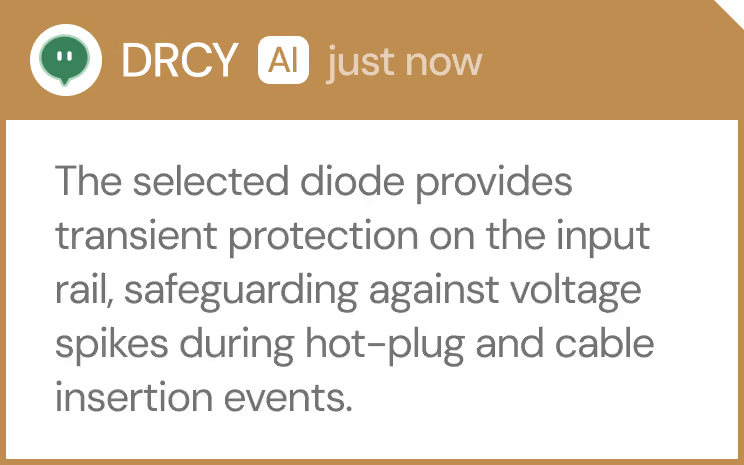
Text message from DRCY AI stating: The selected diode provides transient protection on the input rail, safeguarding against voltage spikes during hot-plug and cable insertion events.
Copper background with circuits

Catch critical issues early.
Ship with confidence.

Unlike general-purpose AI tools, DRCY (pronounced "DAR-SEE")  connects directly to native schematic data and component datasheets to surface potential issues and failure modes during the design process.

A stylized green robot head with two circular ears, white rectangular eyes, a red headband, and holding a yellow screwdriver in its right hand.

One AI agent.
Two complementary capabilities.

DRCY Reviews

Review. Validate.
Catch things you might have missed.

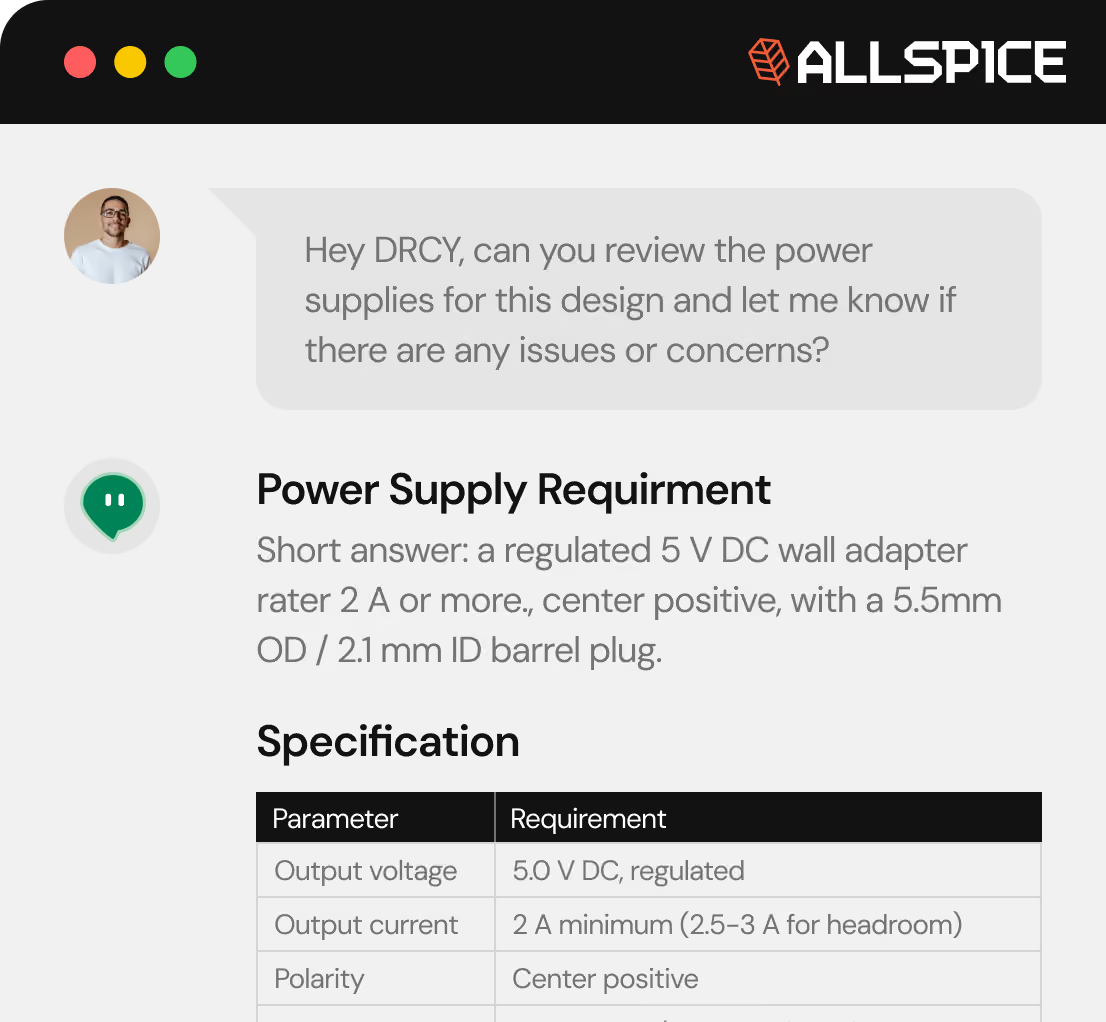
DRCY Reviews provides a broad, systematic review of your design. It works methodically across the design to surface potential issues and blind spots you might not have thought to check.
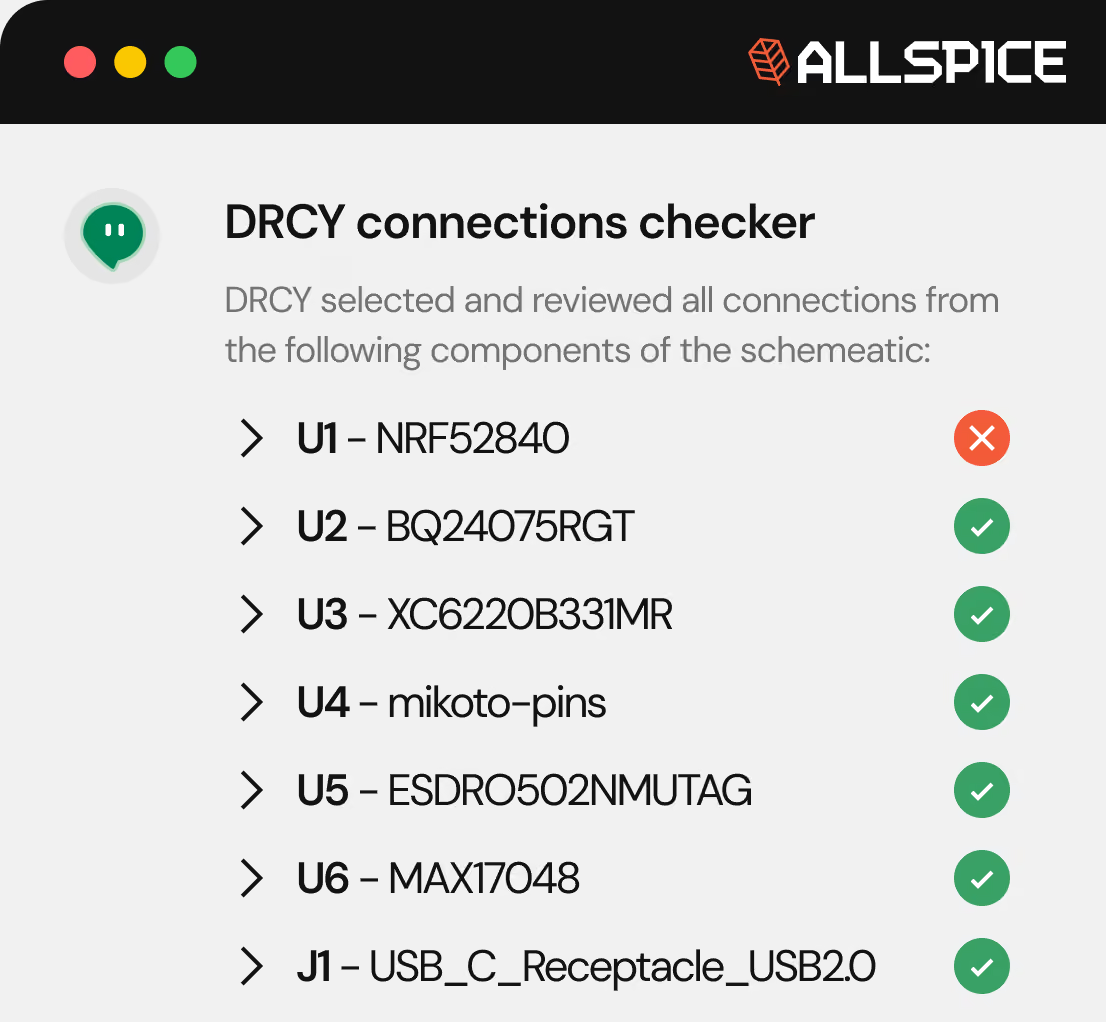
DRCY connections checker interface by ALLSPICE showing a list of components and their connection status; U1 - NRF52840 marked with a red cross indicating failure, U2 to U6 and J1 components all marked with green check marks indicating successful connections.
Screenshot of a chat window from Allspice with a user asking DRCY to review power supplies for a design. The response outlines the power supply requirement: a regulated 5 V DC wall adapter with at least 2 A, center positive, and 5.5mm OD / 2.1 mm ID barrel plug. A specification table lists parameters and requirements: output voltage 5.0 V DC regulated, output current minimum 2 A (2.5-3 A for headroom), and polarity center positive.

Chat with DRCY

Ask. Investigate. Analyze.

Chat with DRCY is a flexible, focused, and steerable way to work with your design at any stage of hardware development. Ask questions, investigate specific components or connections, explore design options, or direct DRCY toward a particular problem.

Free your team to focus on architecture, design improvements, and what matters most.

Status quo
Manual reviews create variability and late surprises.
That nagging uncertainty before sign-off: did I miss something critical?
Digging through endless schematics, datasheets, and documentation to investigate a particular component.
Time-consuming rechecks of fundamentals you've verified a dozen times before.
Switching between multiple tools and documents to find answers to design questions.
Creating analysis reports means tedious hand calculations and entering data into spreadsheets.
With DRCY
Comprehensive checks run automatically, every time.
Systematic review surfaces issues you may not have thought to look for.
Relevant design data is connected automatically when investigating the design.
Checks are flexible and scoped as you need for your design process.
Design questions answered conversationally, in context.
Analysis tables and reports generated by prompt, without manual data entry.
Abstract geometric shapes formed by green and white lines on a black background creating angular designs in the corners of the image.
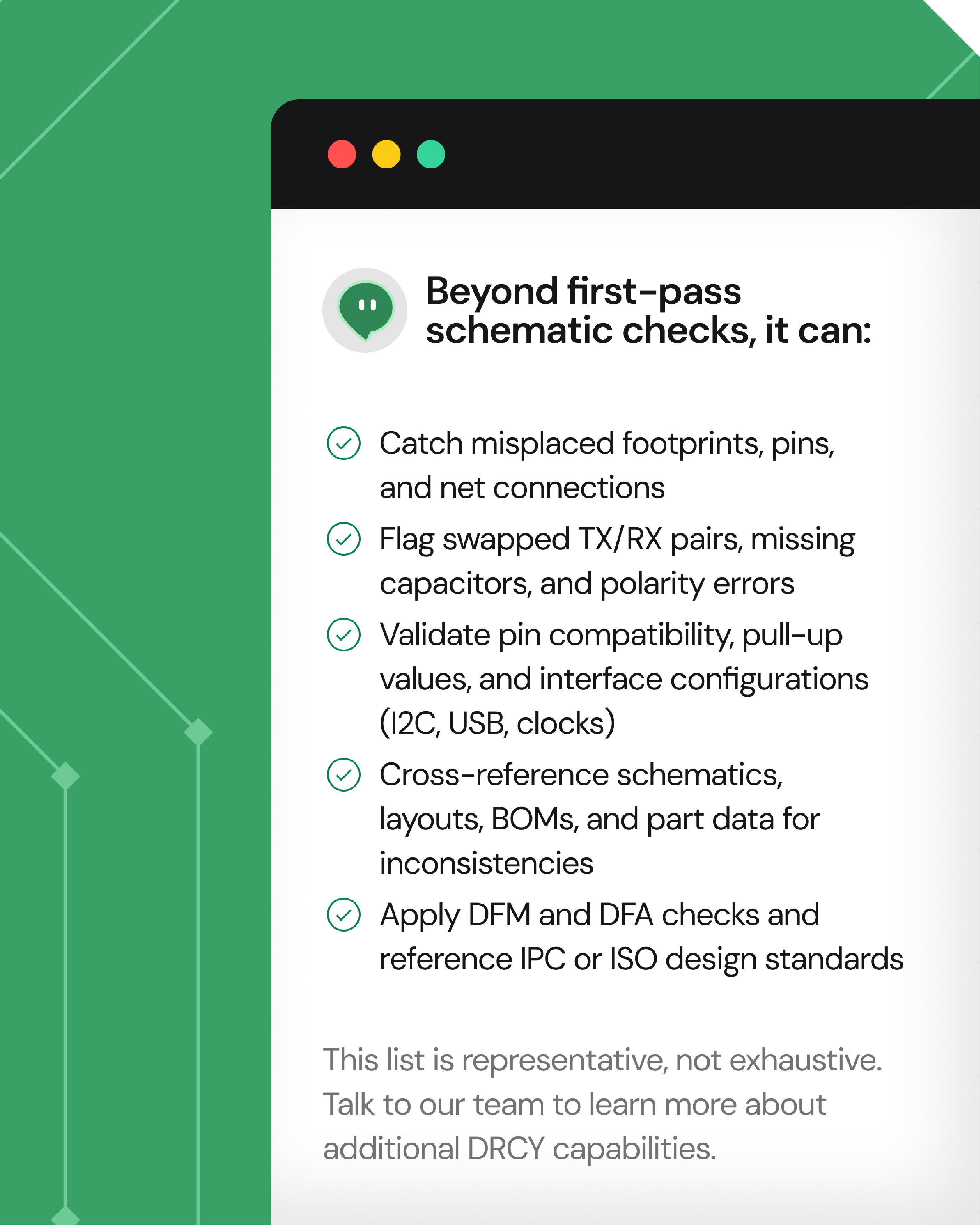
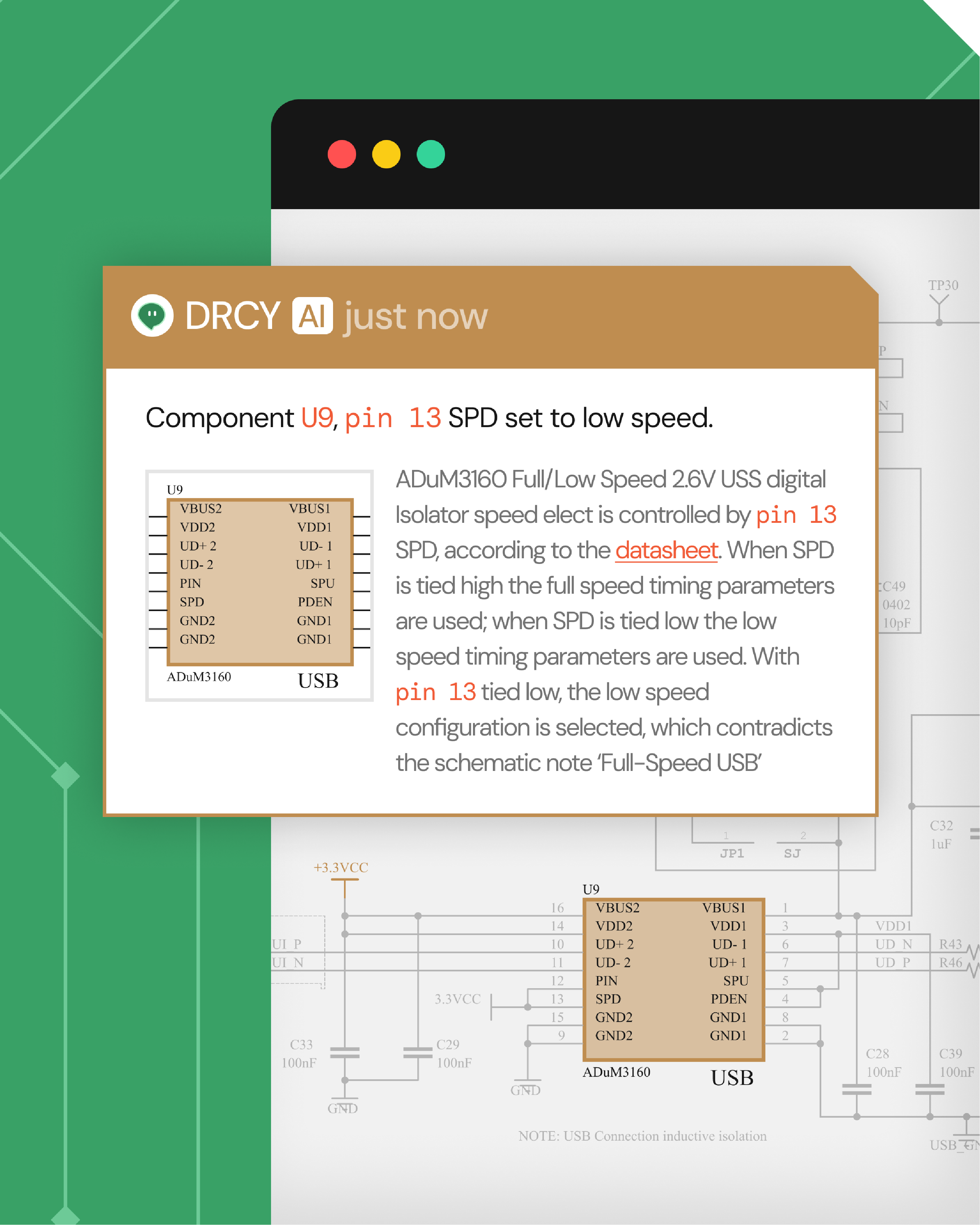
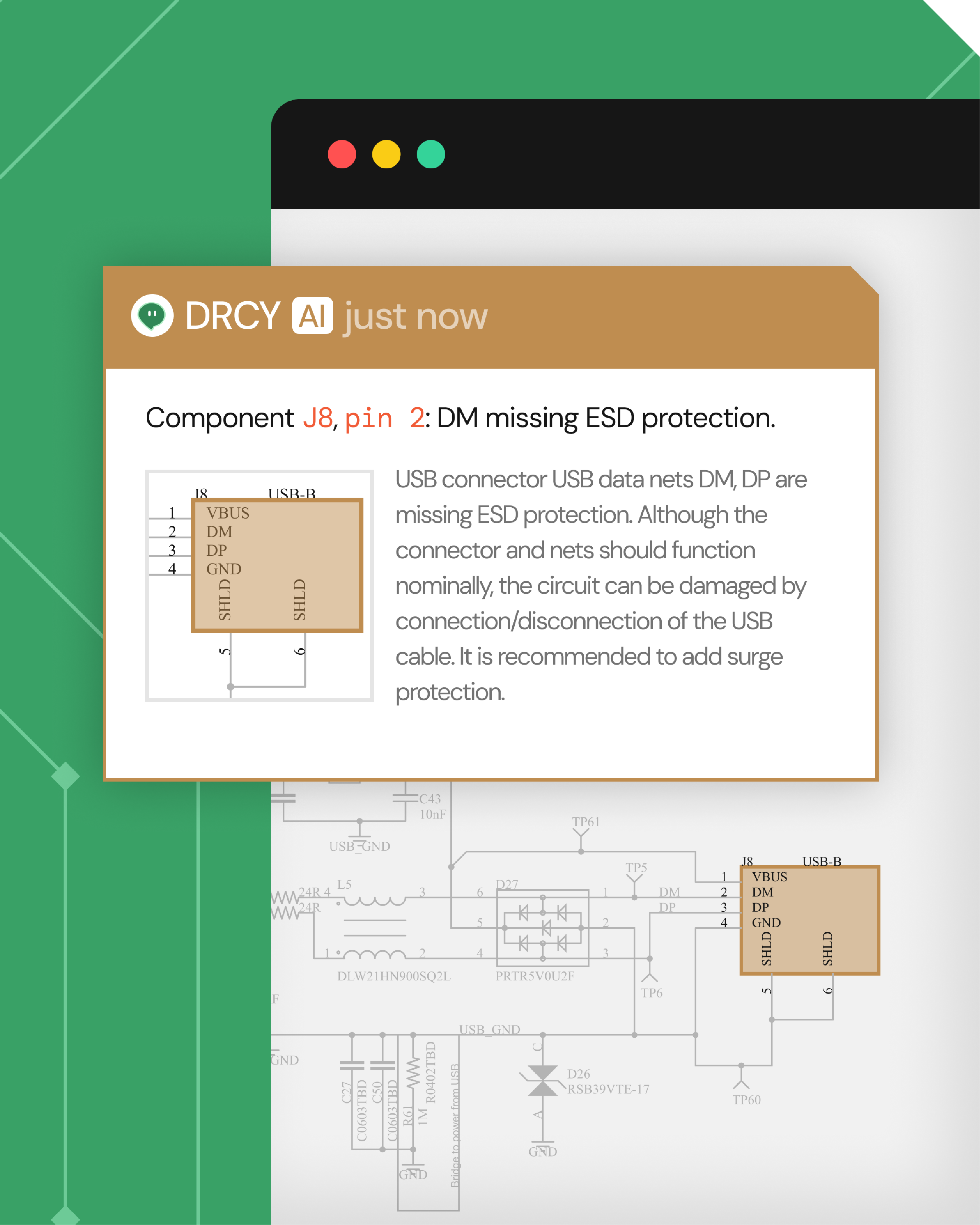
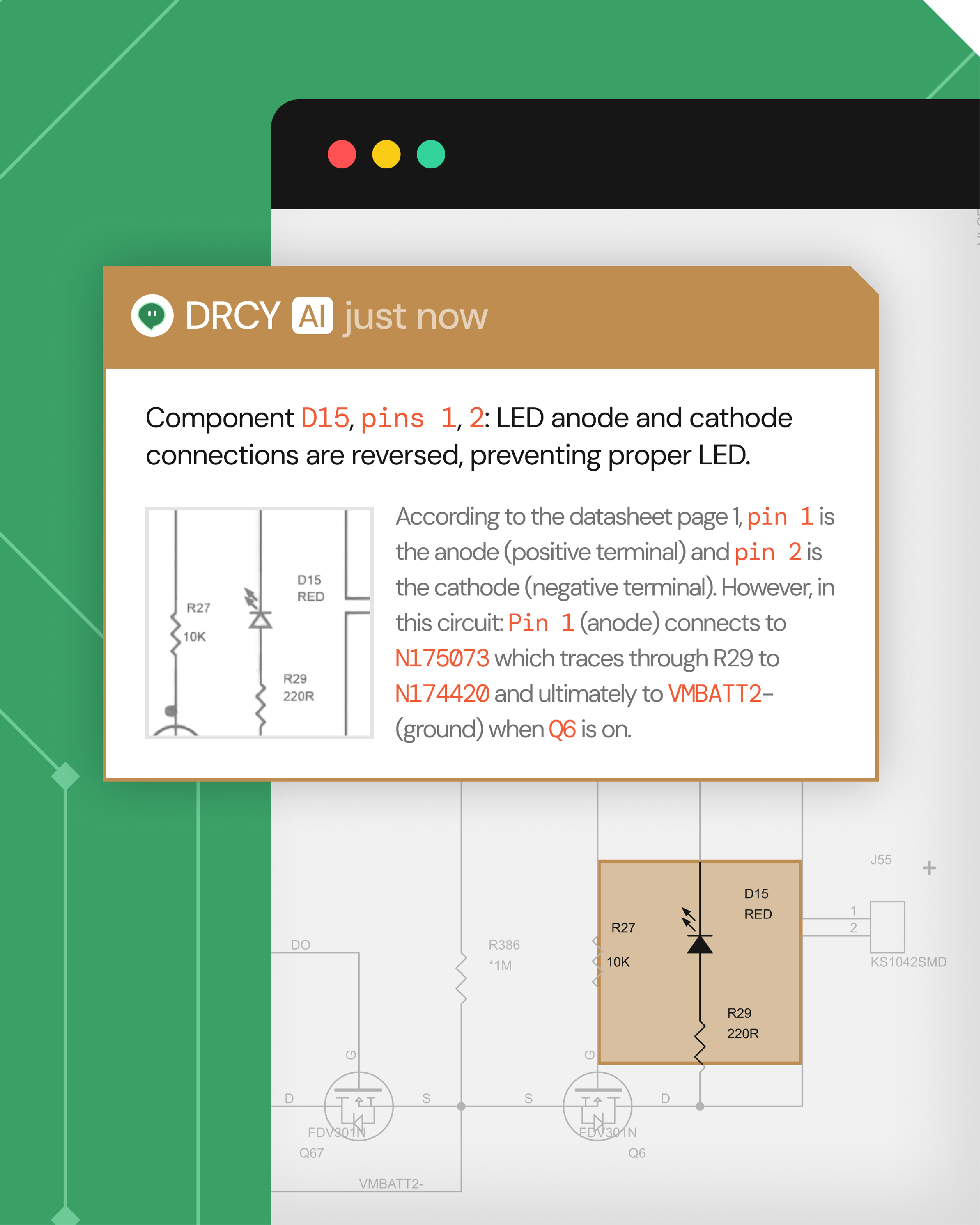
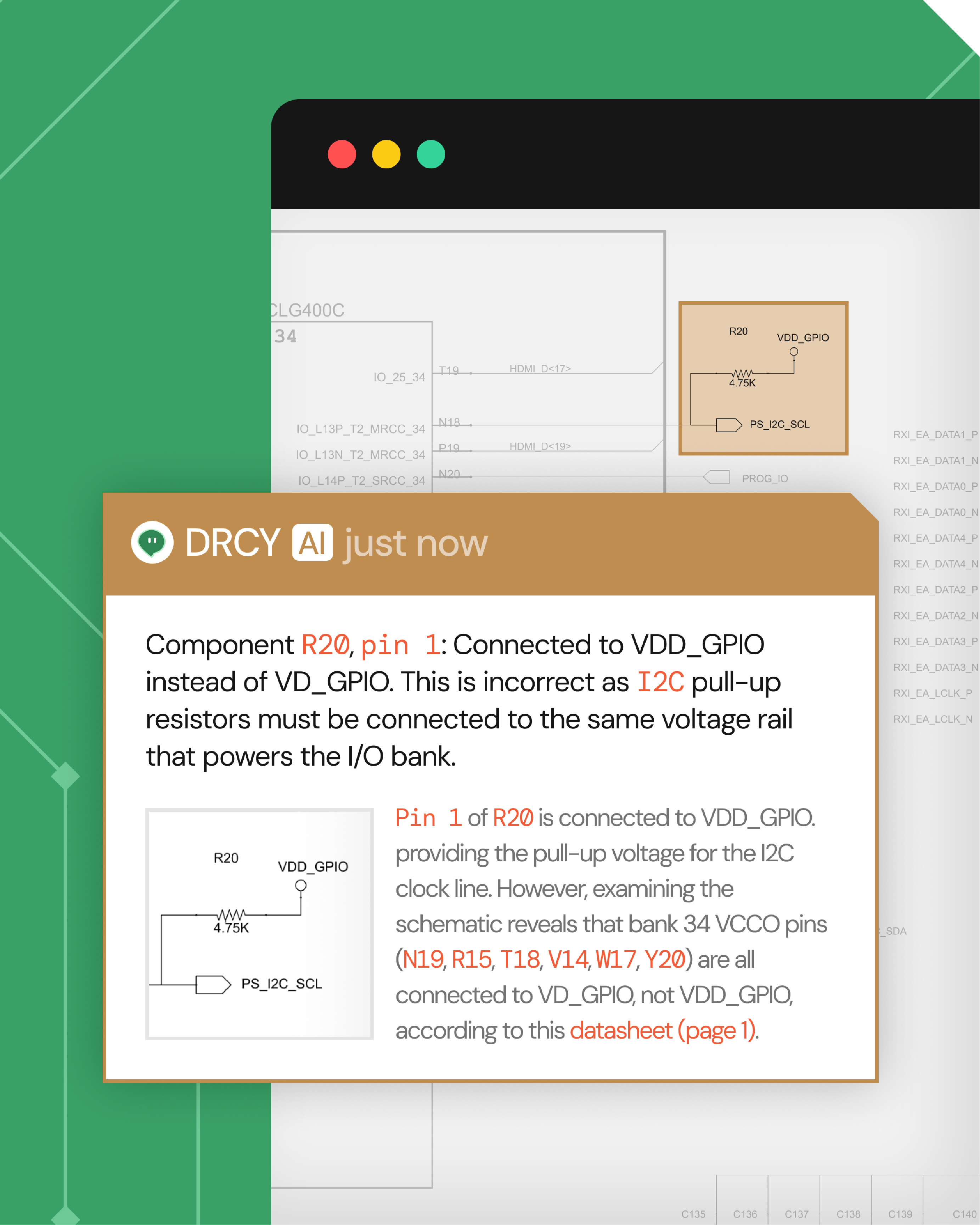
A list detailing capabilities beyond first-pass schematic checks, including catching misplaced footprints, pins, and connections; flagging swapped TX/RX pairs and polarity errors; validating pin compatibility, pull-up values, and interface configurations like I2C, USB, and clocks; cross-referencing schematics, layouts, BOMs, and part data for inconsistencies; and applying DFM and DFA checks referencing IPC or ISO standards. A note states the list is representative, not exhaustive, inviting users to consult the team for more DRCY capabilities.A digital notification window against a green background shows a message from DRCY AI stating that component U9, pin 13 SPD is set to low speed. It includes a diagram of U9, a USB digital isolator chip with pin labels, and explains that pin 13 SPD controls speed selection between full and low speed according to a datasheet. The message notes a contradiction because pin 13 is tied low indicating low speed, which conflicts with the schematic note stating 'Full-Speed USB'.Alert message from DRCY AI stating: 'Component J8, pin 2: DM missing ESD protection.' It explains USB connector data nets DM and DP lack ESD protection, risking circuit damage from USB cable connection/disconnection, and recommends adding surge protection. A schematic snippet highlights USB-B connector pins VBUS, DM, DP, GND, SHLD with pins 5 and 6 connected to shield.Highlighted DRCY AI warning on a circuit schematic states component D15 LED anode and cathode pins 1 and 2 are reversed, preventing proper LED function; pin 1 is anode, pin 2 is cathode, but in this circuit pin 1 connects to ground through components when Q6 is on.Text box titled 'DRCY AI just now' explaining that component R20, pin 1, is connected to VDD_GPIO instead of VD_GPIO, which is incorrect for I2C pull-up resistors that must connect to the same voltage rail as the I/O bank. Includes a small circuit diagram showing R20 connected with a 4.75K resistor to VDD_GPIO and PS_I2C_SCL. Additional text notes bank 34 VCCO pins (N19, R15, T18, V14, W17, Y20) connect to VD_GPIO, not VDD_GPIO, per datasheet reference.

Examples of DRCY catches

DRCY surfaces critical hardware design errors during the engineering process that could otherwise lead to costly rework, board respins, or production failures.

Voltage Mismatches

Voltage configurations that violate component operating limits
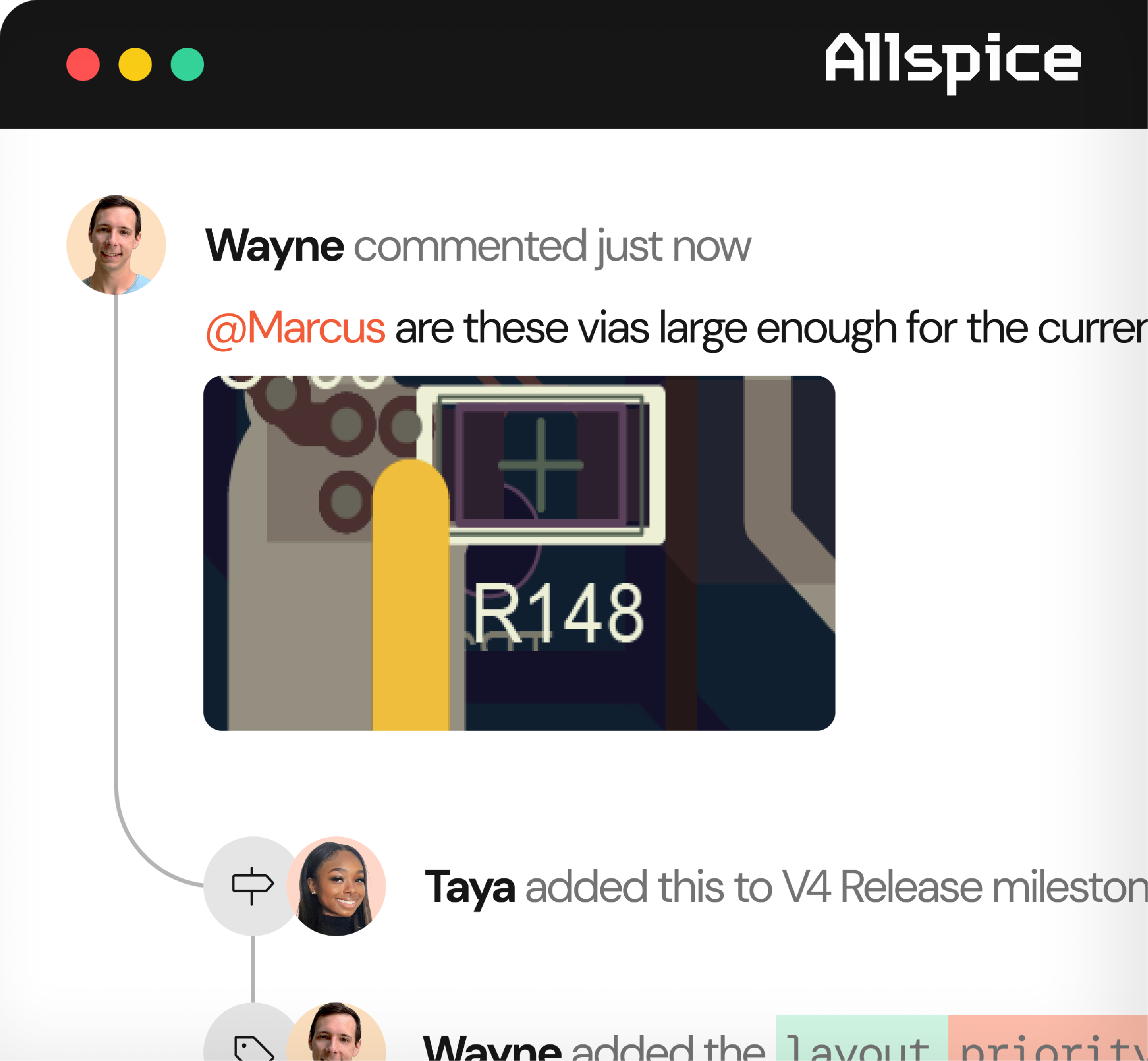
A collaboration chat interface from Allspice showing a message from Wayne asking Marcus if the vias on a circuit board image are large enough, followed by a note that Taya added this to the V4 Release milestone.
Incorrect Pin Usage

Pin assignments that break datasheet electrical specifications, including swapped signals or invalid pin roles

A collaboration chat interface from Allspice showing a message from Wayne asking Marcus if the vias on a circuit board image are large enough, followed by a note that Taya added this to the V4 Release milestone.
Missing ESD

Missing pull-ups, terminations, or protection circuits on user facing or external interfaces

A collaboration chat interface from Allspice showing a message from Wayne asking Marcus if the vias on a circuit board image are large enough, followed by a note that Taya added this to the V4 Release milestone.
Misconfigured Settings

Incorrect configuration register settings that violate datasheet requirements

A collaboration chat interface from Allspice showing a message from Wayne asking Marcus if the vias on a circuit board image are large enough, followed by a note that Taya added this to the V4 Release milestone.
And More

DRCY acts like adding a superhuman reviewer to your team.
A collaboration chat interface from Allspice showing a message from Wayne asking Marcus if the vias on a circuit board image are large enough, followed by a note that Taya added this to the V4 Release milestone.

Engineering excellence, supercharged.

System level reasoning on real design data.

DRCY analyzes your native design files, component libraries, datasheets, and organizational context. It evaluates connections, configurations, and electrical limits the way engineers reason about complete systems, not isolated nets.

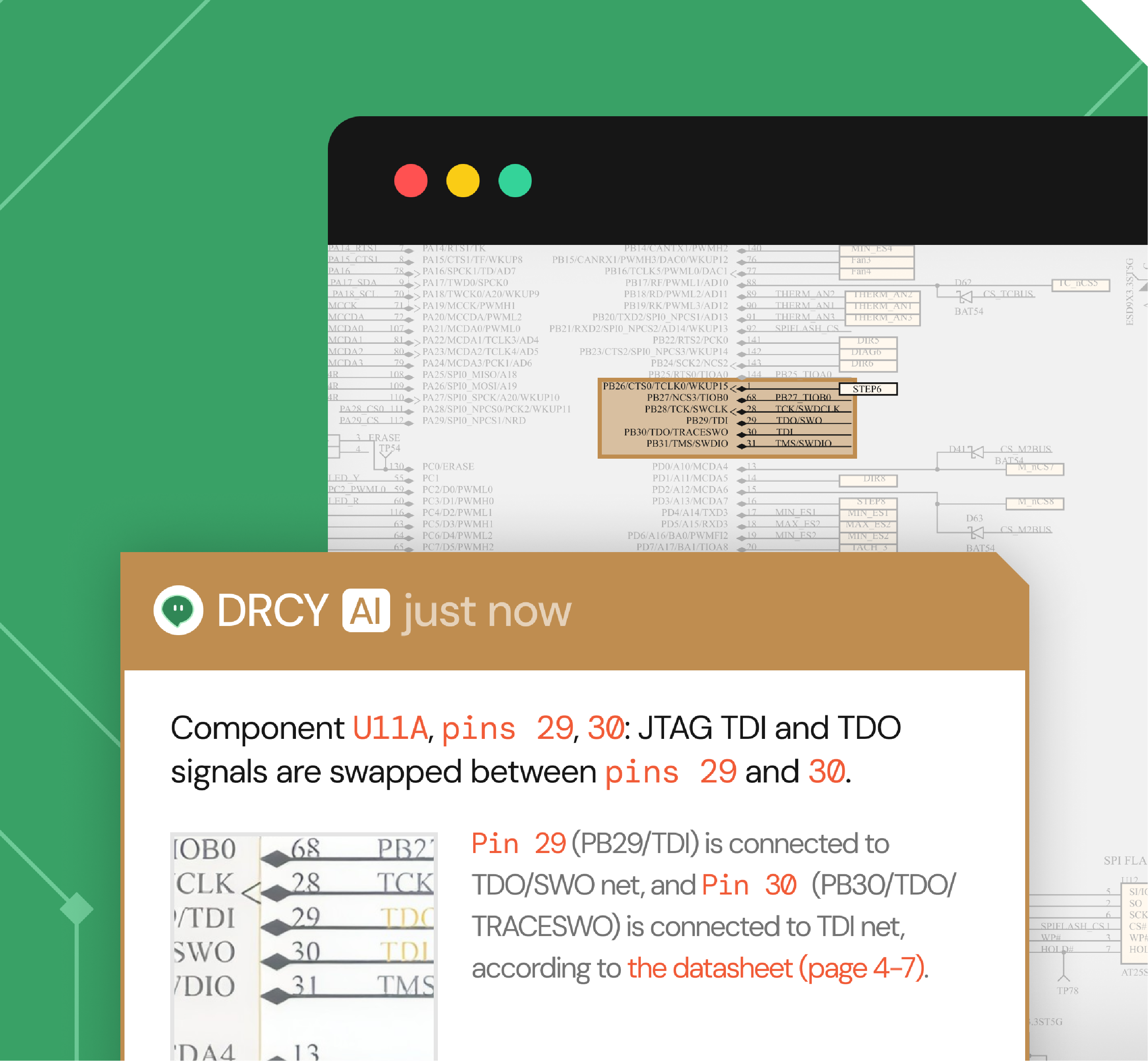
Green background with a central chat bubble icon connected by lines to four smaller circular icons representing data chart, bar graph, group of people, and award ribbon, with a small pop-up window showing an AI assistant notification about swapped JTAG TDI and TDO signals on pins 29 and 30 of component U11A.
Screenshot of a message from DRCY AI explaining that for component U11A, JTAG TDI and TDO signals are swapped between pins 29 and 30, with details on the pin connections and reference to the datasheet.

Inspectable, evidence based findings

Every issue DRCY flags appears directly on the source schematic. Findings link to the exact datasheet section, pin requirement, or constraint that triggered the check. Results are traceable, auditable, and easy to verify.

Focused analysis at any stage of hardware development

Chat with DRCY lets designers ask about specific elements they want to investigate, add context, and create reports. Questions can be asked in plain language, with answers grounded in connected organizational data, schematics, and datasheets - no data prep, no scripting, just the design, ready to answer.
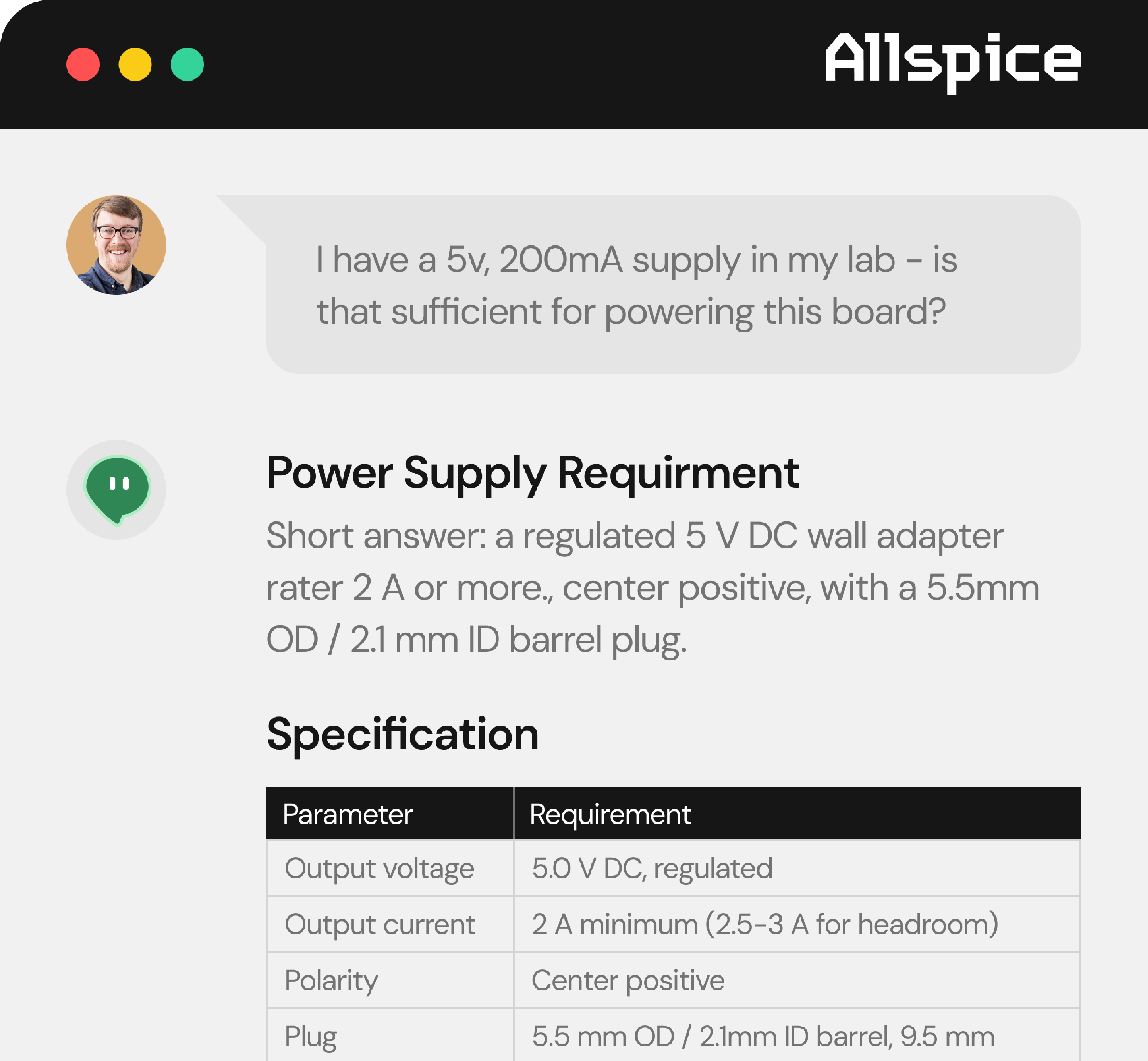
Chat interface with a user question asking if a 5V, 200mA supply is sufficient for powering a board. The response states the power supply requirement: a regulated 5V DC wall adapter rated 2A or more, center positive, with a 5.5mm OD / 2.1mm ID barrel plug. A specification table lists output voltage as 5.0 V DC regulated, output current 2 A minimum (2.5-3 A for headroom), polarity center positive, and plug size 5.5 mm OD / 2.1mm ID barrel with 9.5 mm length.
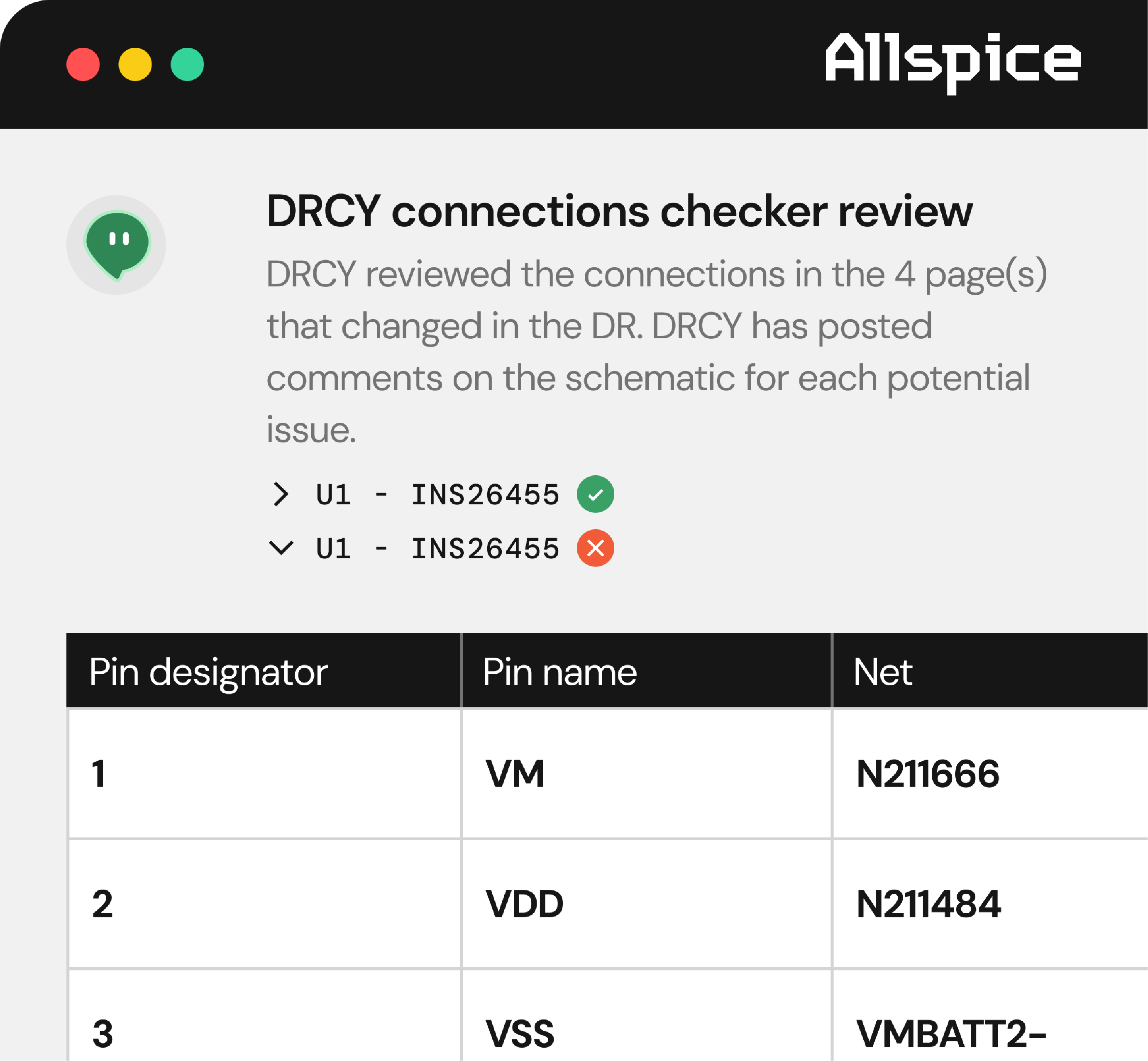
Screenshot of DRCY connections checker review on Allspice showing that DRCY reviewed connections in 4 pages with comments on schematics, listing U1 - INS26455 with a green check and red cross, and a table displaying pin designators 1 to 3 with corresponding pin names VM, VDD, VSS, and nets N211666, N211484, and VMBATT2- respectively.

Early detection before costly changes

DRCY Reviews runs during design reviews, before layout and handoff. It catches common issues such as power misconfigurations, pin violations, and missing protections when fixes take minutes instead of triggering respins.

AI-powered reviews, human owned decisions

DRCY operates with a human-in-the-loop philosophy. Engineers review, validate, and act on findings before sign off. DRCY delivers checks throughout development; engineers handle validation, judgment, and make the final call on every issue.
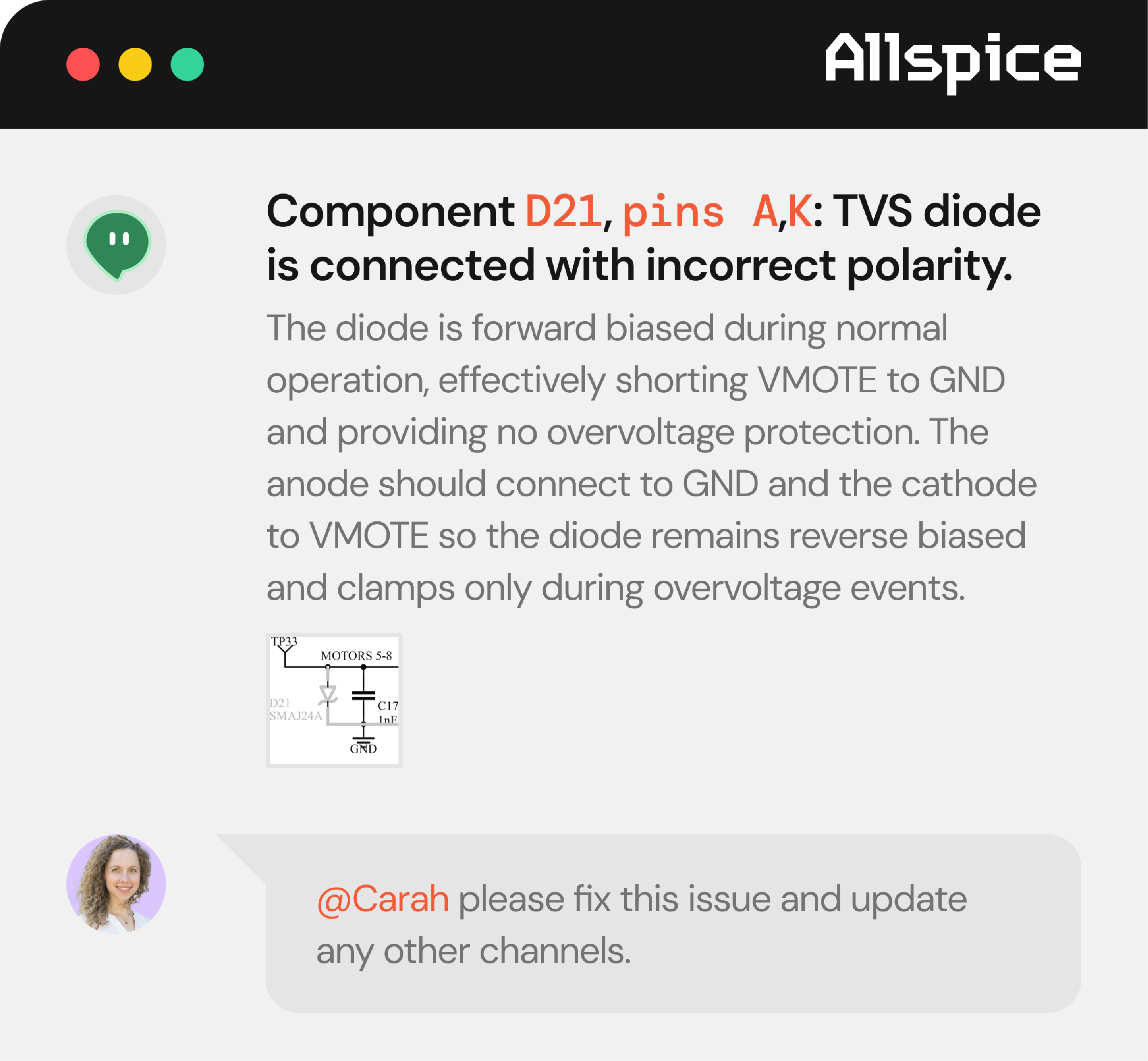
Chat interface from Allspice showing a technical issue: Component D21, pins A and K, TVS diode connected with incorrect polarity. Explanation states the diode is forward biased during normal operation, shorting VMOTE to GND and providing no overvoltage protection. Correct connection should have anode to GND and cathode to VMOTE to keep diode reverse biased and clamp only during overvoltage. A small schematic diagram of the diode wiring is visible. A user named Carah is requested to fix the issue and update other channels.

Frequently Asked Questions

How does Allspice handle AI data privacy?

Your design data stays yours. We never use customer data to train foundation models. DRCY runs within AllSpice's existing security architecture and is GDPR compliant. Learn more at the AllSpice | Trust Center.

How does Allspice protect our data?

Data encryption in transit and at rest, role-based access controls, regular security audits, and SOC 2 Type II compliance. Full details available during security review.

How does DRCY access the relevant datasheets?

If part numbers are included in the component information, DRCY pulls datasheets from the web by default. If a datasheet isn't found, you can upload it manually. Enterprise deployments can link to internal managed datasheets and systems. For more information, contact us.

How do I get started with DRCY?

DRCY can be called to review your schematic from within an AllSpice Design Review. For more information, visit our documentation on DRCY. You will only need your current design and accurate part numbers for the datasheet references.

How can I trust the results of an AI?

Our AI doesn’t replace verification. It’s a first-pass check that augments your busy engineering team. Instead of diverting your team to try and verify everything, they only need to verify the issues DRCY flags.

Where is customer data hosted?

AllSpice's cloud infrastructure runs on Amazon Web Services (AWS) in the United States by default. Enterprise customers can discuss hosting and deployment options, including self-hosted or alternative geographic deployments, during security review.

Can we speak directly to your security team?

Yes. Security reviews and direct conversations with our security team are available during the sales process. Contact info@AllSpice.io to learn more.

What ECAD file formats does DRCY support?

DRCY currently can review schematic files from most ECAD formats including System Capture, Altium, OrCAD, Allegro, and KiCAD. Visit this link to see all the file formats that AllSpice supports.

Can I self-host?

Self-hosted deployment options are available for enterprise customers. Contact our team to discuss requirements.

Where can I find more information?

You can find more information in our documentation or by booking a demo.

Still have questions?
Contact Us