A 90-day plan for rolling out AI in engineering teams
Ready to scale AI in hardware engineering? Move from experiment to execution with our 90-day phased roadmap. Learn how to launch a high-trust pilot, expand across teams, and drive measurable ROI with a structured, workflow-first approach.
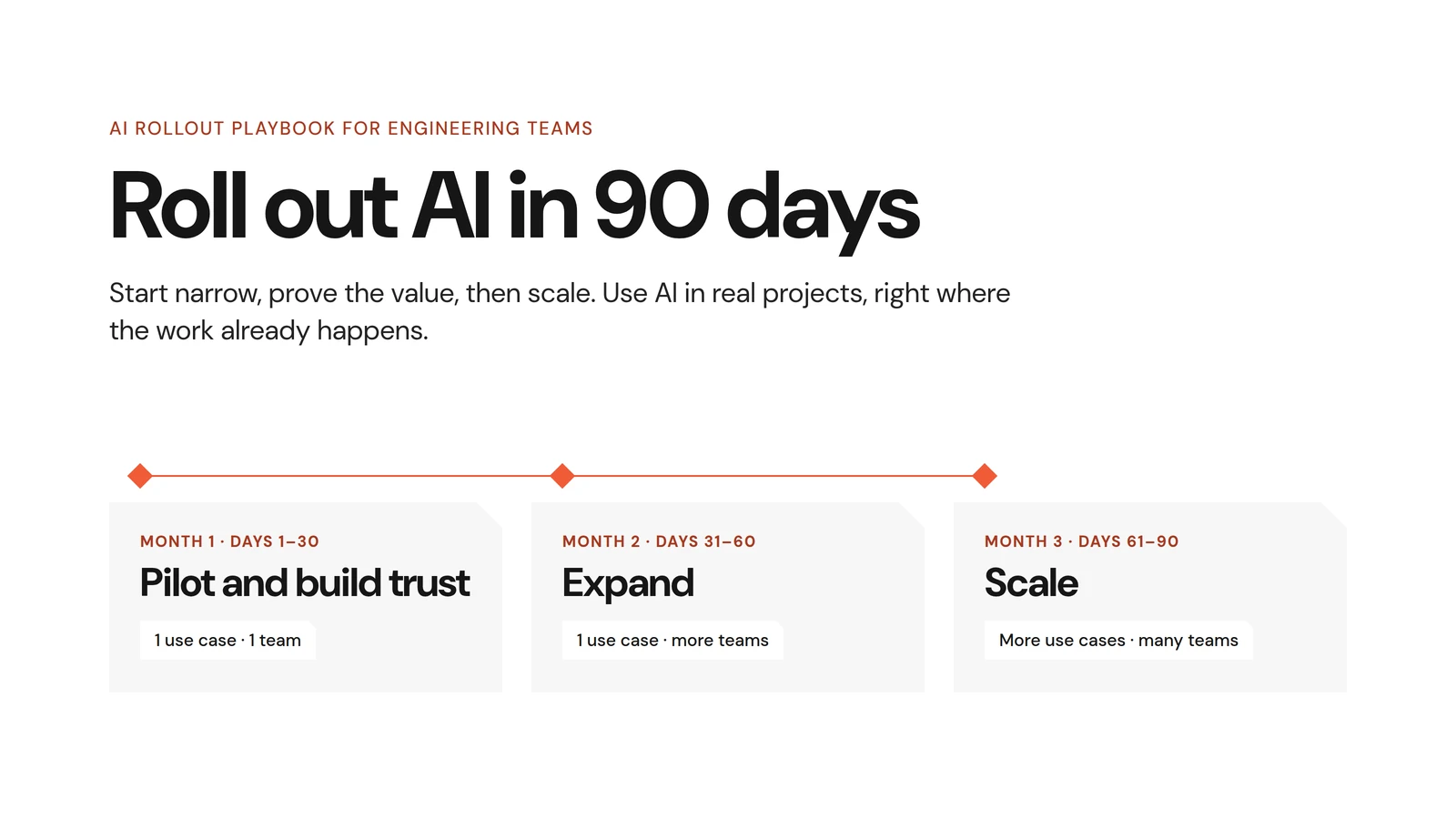
The most successful AI rollouts here at Allspice share a common thread: a structured approach with clear goals, not experimentation. If you want to see if AI is effective in your engineering teams, start with a detailed plan that incrementally introduces AI to the process. As I covered in my previous blog, the myth is that AI is a change management problem when it's actually a workflow problem. The teams getting real value from AI use it exactly where work already happens. That's the basis of this three-phased approach over 90 days, where your team uses AI in real projects, in real processes, to see where it can deliver value.
Month 1: pilot and build trust (Days 1–30)
In the first 30 days, I advise teams to start narrow. Pick a single, well-defined use case where human supervision is straightforward, like design reviews. They are a concrete point in time that every team already knows the process. It's a great place for them to supervise what the AI agents are doing.
During this initial phase, your team is building trust with the system. They will need to clearly identify the risks they are trying to mitigate, define the specific tasks, and establish guardrails regarding what the AI will do, what it won't do, and how it should interact with the engineering team.
One question I frequently get is how to structure that pilot team. Is it better to pull one engineer from five different teams, or to select a single, complete team of five? In my experience, the second is consistently more successful. It's best to have a quorum of engineers who are already working together to test the value of AI.
There's also the question of what data to use. Mock data or fake release processes is not the best test. You won't know if AI truly fits your needs unless you use it live, in a real project, in real time.
Here are the steps to execute in the first month:
- Identify 2–3 high-frequency, high-impact risks.
- Define baseline metrics: review latency, defect stage, and rework hours.
- Train pilot engineers on workflow changes.
- Document guardrails: establish that AI is advisory, not authoritative.
Month 2: expansion (Days 31–60)
Once you've seen the value of AI in the first use case, the next step is to expand from one use case/one team to one use case/multiple teams. In this stage, you can begin to capture meaningful ROI. You can track metrics like hours saved, errors caught, or improvements in board quality, depending on what you're optimizing for. With that data, you can get a clear, objective view of whether AI is bringing value worth continuing to expand.
To keep the momentum going, focus on these activities during the second month:
- Expand the pilot to 1–2 additional teams.
- Add gated checks, such as automated BOM sanity and footprint validation.
- Publish your first ROI snapshot: highlight hours saved and early errors caught.
- Gather feedback from managers and individual contributors on usability.
- Begin internal communications: highlight early wins and share role-specific guides.
Month 3: scaling (Days 61–90)
The third month focuses on applying multiple use cases across many teams to expand the scope of what AI can do. This is the roadmap I've seen work in the most successful rollouts. By following the progression from a structured single-team pilot to a multi-team standard process, engineering teams can see where AI delivers value in their workflows.
To standardize your AI approach across the organization:
- Roll out an org-wide "definition of done" that includes AI checks.
- Add additional checks, such as datasheet validation and compliance templates.
- Harden system integrations and permissions.
- Publish a 90-day ROI report with clear before/after comparisons.
- Plan next quarter's expansion: target more teams with more use cases.
Use these principles to guide your AI journey
We've covered a lot of ground in these three blogs about a tactical, phased rollout of AI into an engineering organization. I've distilled it down into six core principles to guide your AI strategy:
- Create a strong data foundation: Get design files structured, versioned, and machine-readable before adding AI.
- Capture design intent: Record design rationale and review history. AI can't infer why decisions were made.
- Pick the right tool: Assign deterministic automation, AI agents, and human judgment to the right tasks.
- Workflow fit matters: Embed AI inside existing engineering workflows, minimizing context switches.
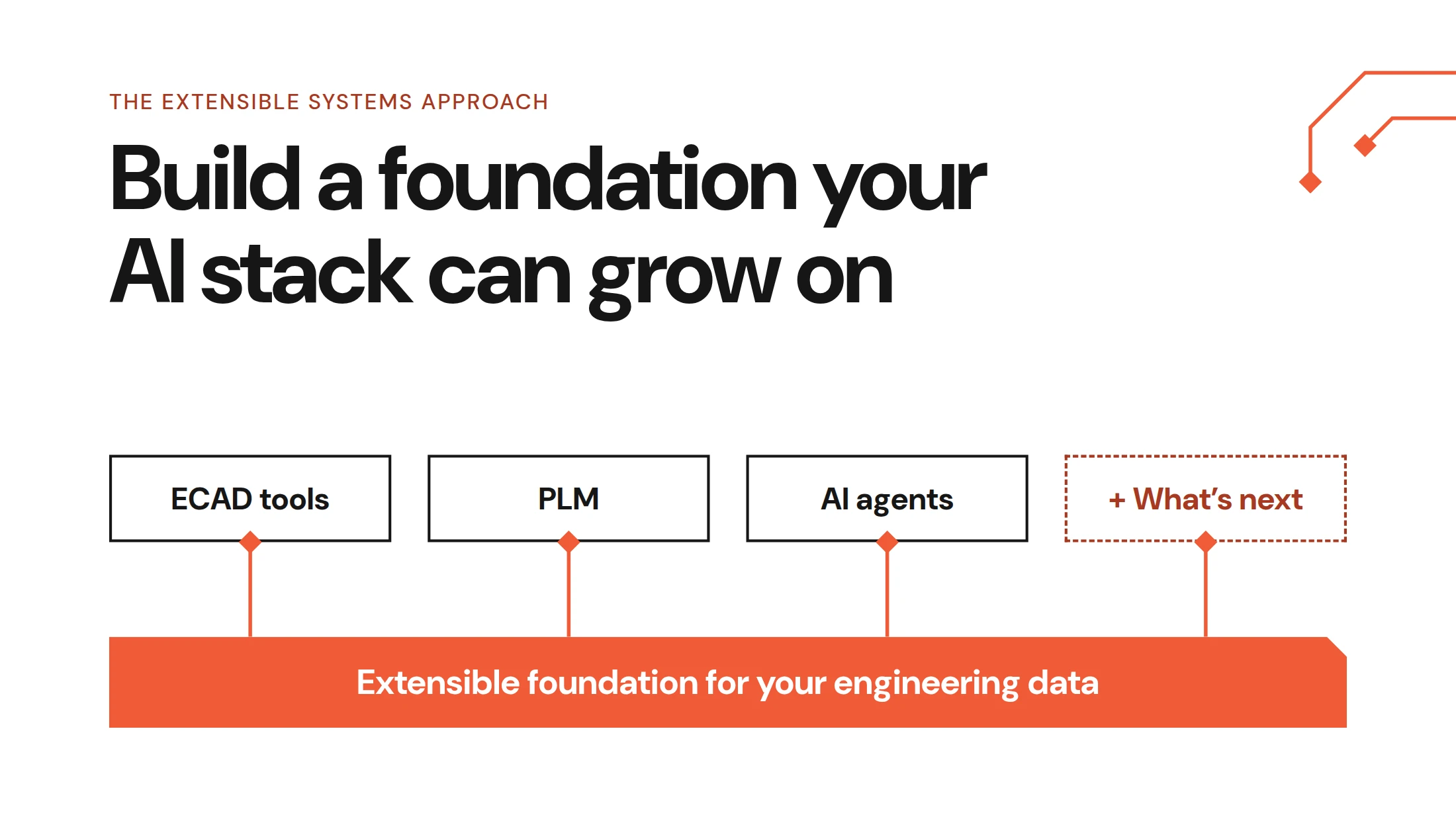
- Plan for extensibility: Build open, connected stacks. Closed tools put a ceiling on AI.
- Start narrow, measure, scale: Start with one workflow, one team, one measurable outcome. Scale what proves valuable.
The strategic value of AI for your engineering team
Using this approach, our customers are seeing measurable ROI. The data shows that AI isn't a buzzword. It's a tool to deliver back engineering design hours, giving engineering teams more time to focus on true innovation. When you can catch defects early and make design reviews more efficient, you aren't just saving costs. You are speeding your time to market. In an engineering world of shrinking talent pools, supply chain cost pressure, and intense competition, AI can be the path to give your teams the competitive edge they need.
Further reading
Don't miss the other blogs in this series:
- Why AI Needs Design Intent: Moving Beyond PDFs in Hardware Engineering: Blog 1 of 3
- When to Use AI in Your Hardware Engineering Process: Blog 2 of 3
FAQs
What's the biggest mistake that hardware teams make when they first try AI?
I think the biggest mistake is misaligned expectations. The reality with AI is that the barrier to entry is deceptively low. Because AI models are so powerful, anyone can build a functional MVP over a weekend. However, there's a big difference between a simple proof-of-concept and a system we can actually trust with mission-critical design data.
That MVP might get you to 80%. But the true challenge lies in that final 20%. As engineering leaders, we have to push past that MVP and focus on the architecture required to reach 100% reliability. AI is a powerful accelerator, but it's that 20% of human effort that transforms an interesting prototype into something trusted and reliable.
How do I get leadership buy-in and budget for an AI pilot?
Frame the pilot around a measurable business outcome, not the technology itself. Leadership doesn't need to hear about the model. They need to hear about the risk you're mitigating (re-spins, schedule slips, defect escapes) and the dollar figure attached to it. Come with baseline metrics before you ask for budget: current review latency, rework hours, and the cost of a typical re-spin. Then propose a scoped, time-boxed pilot (see the 30/60/90 plan above) with a defined checkpoint to report ROI. Framing it as a bounded experiment with a built-in off-ramp makes it a much easier yes than an open-ended AI initiative.