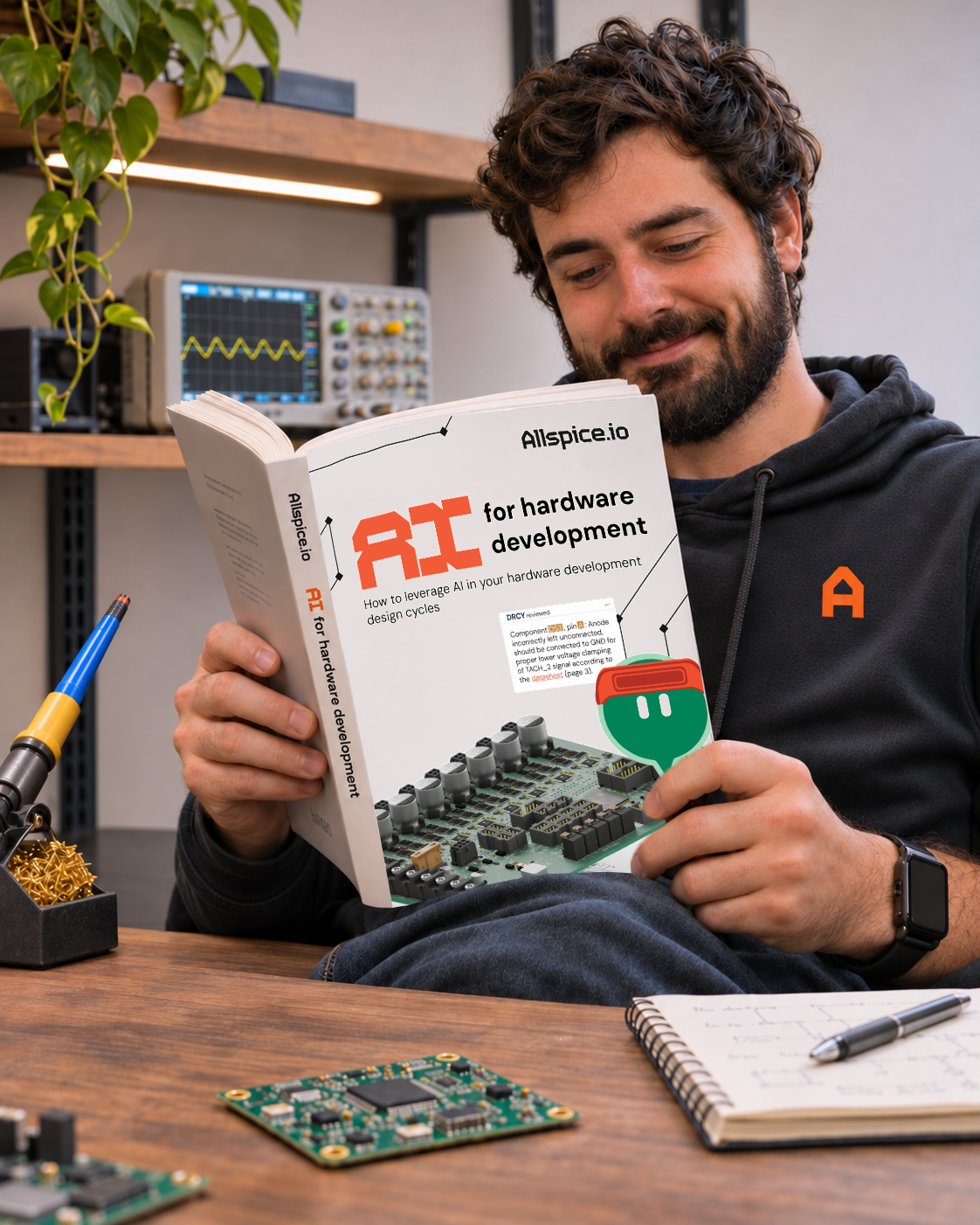
AI for hardware development
Electrical Engineers, PCB Designers, and Hardware Engineers can now integrate artificial intelligence directly into their hardware workflows, from circuit simulation and schematic capture to PCB layout, testing, and automation. By applying AI to the hardware design process, teams can accelerate design cycles, reduce errors, and achieve more confident design reviews.
Chapters
Read it online, one chapter at a time.
Board respins cost 4–6 weeks and up to $100K each. Learn how AI design review is following the path of CAD and PLM to cut respins and speed hardware launches.
See how AI catches wrong footprints, cleans up BOMs, builds power tables, and maps hardware to firmware, so engineers spend less time on manual reviews.
Learn how to roll out AI in hardware engineering: pick high-impact use cases, start with low-risk checks, keep humans in the loop, and prove ROI in 90 days.
Learn why general AI struggles with ECAD data, and how Allspice parses designs into structured data so DRCY can run datasheet-aware reviews in pull requests.
What’s next for AI in hardware design: project templates, ECAD-trained models, automation-first workflows, and direct links to simulation and CM systems.
From slide rules to CAD to PLM, every computational leap reshaped engineering. AI is next, and it’s moving faster, making standing still the riskiest choice.
About the author