Missing or inconsistent component attributes
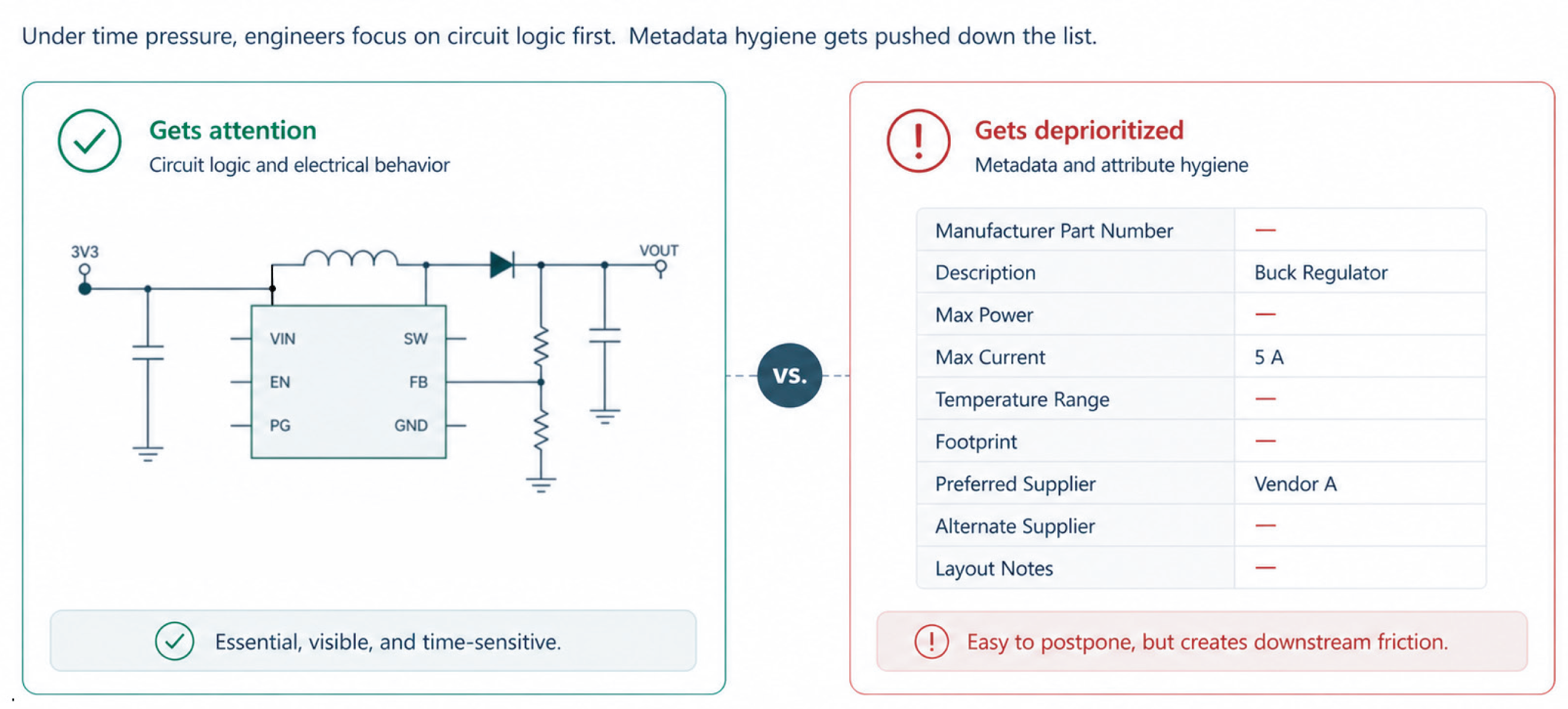
Not every costly review problem is electrical. Some of the most persistent downstream issues come from metadata that looks minor in the moment but creates friction for procurement, documentation, manufacturing, and change control later on.
Typical attribute problems:
- Missing manufacturer part numbers
- Inconsistent naming conventions
- Duplicate or conflicting fields
- Unclear lifecycle or sourcing information
- Fields that are present in one section of the design and missing in another
Why engineers deprioritize this work
Attribute checking is necessary, but it is rarely the part of the job anyone is excited to do. When a team is trying to finish a review, visual circuit logic naturally gets more attention than metadata hygiene. That is understandable. It is also why these issues often persist until they interrupt someone else downstream.
A current-limit setting that does not match the design intent
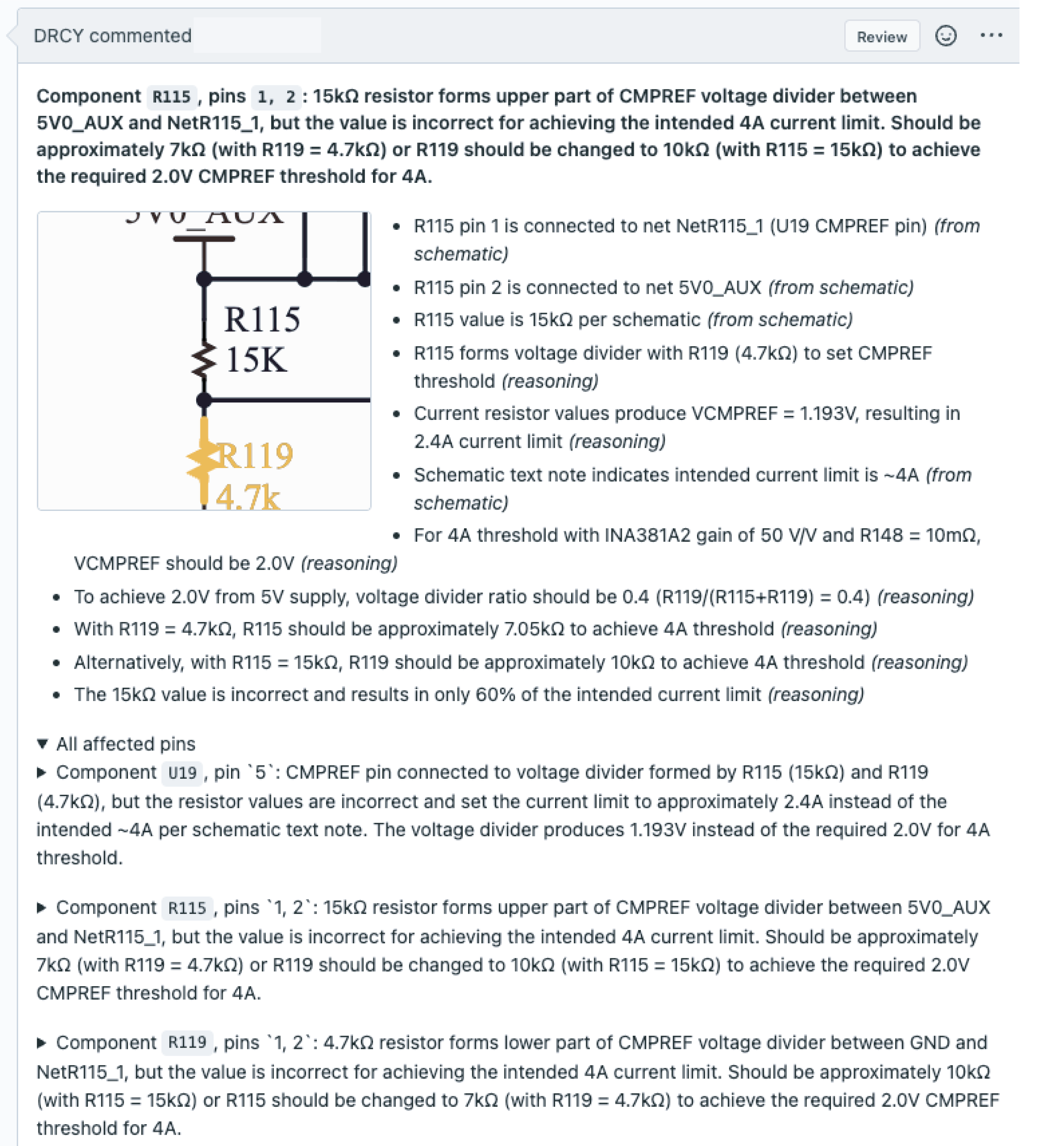
One useful example is a design that looks documented, but where the values and stated intent no longer line up. In this DRCY finding, the system flagged resistor `R115` in the `CMPREF` voltage divider and explained that the selected values would not achieve the intended 4A current limit noted in the schematic. The review traced the divider formed by `R115` and `R119`, referenced the stated target behavior, and showed that the current resistor values would produce a threshold closer to 2.4A instead of the intended 4A.
What makes this example useful is that it shows how design-data issues can extend beyond missing fields or inconsistent labels. Here, the problem is that the documented intent, component values, and resulting behavior no longer agree with each other.
- The schematic note says the design is targeting a 4A limit.
- The resistor values in the design produce a different threshold.
- DRCY shows the calculation path behind that conclusion.
- The finding also suggests concrete value changes that would restore the intended behavior.
That traceability is important. Instead of asking the reviewer to notice a subtle mismatch by memory, DRCY shows the relevant components, the stated design goal, the resulting electrical behavior, and the reasoning that connects them.
The business impact
Messy attributes can slow BOM generation, create confusion in handoffs, and introduce errors that affect procurement or manufacturing readiness. They rarely look urgent when they are first noticed, but they can still be expensive.
How AI-assisted review helps
AI can scan for missing fields, inconsistent formatting, conflicting values, and other repeatable data-quality issues much faster than a person doing the same work manually. That helps electrical engineers spend more time on design decisions while giving managers cleaner, more trustworthy information for the teams that depend on accurate design data.
The final category shows up a little differently. Even when a design starts in good shape, risk can be introduced quietly as the schematic evolves from one revision to the next.