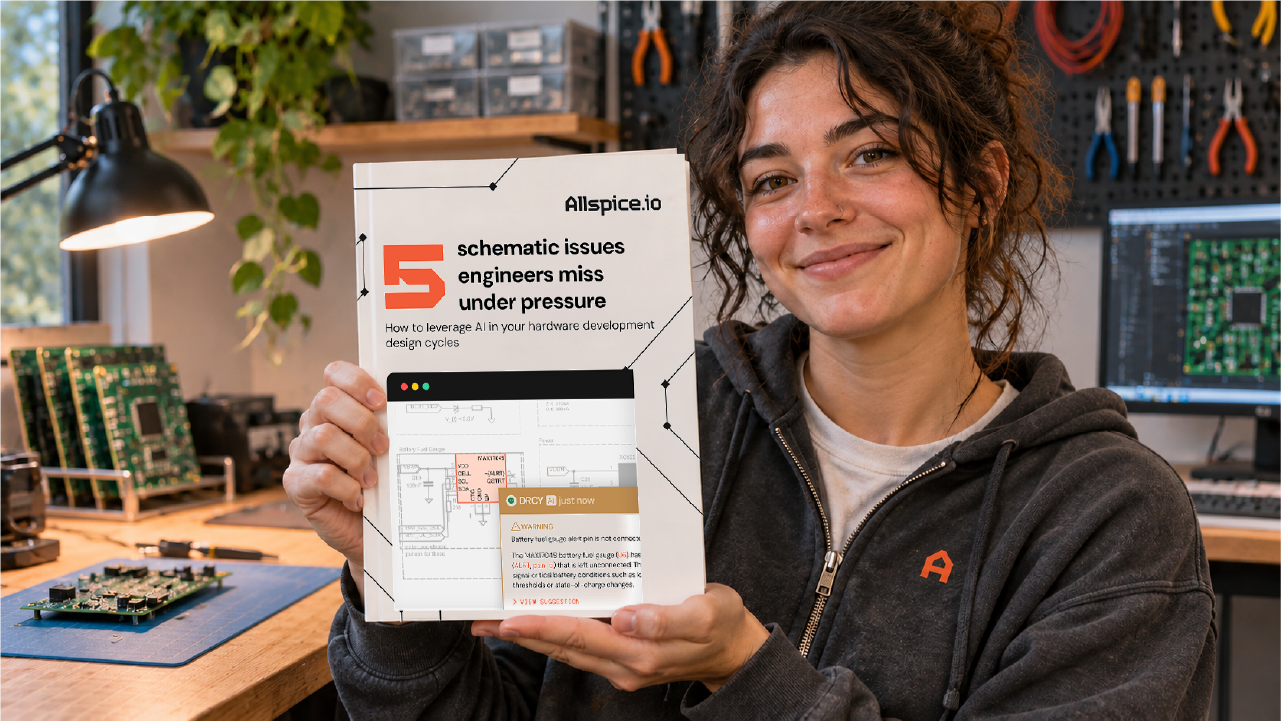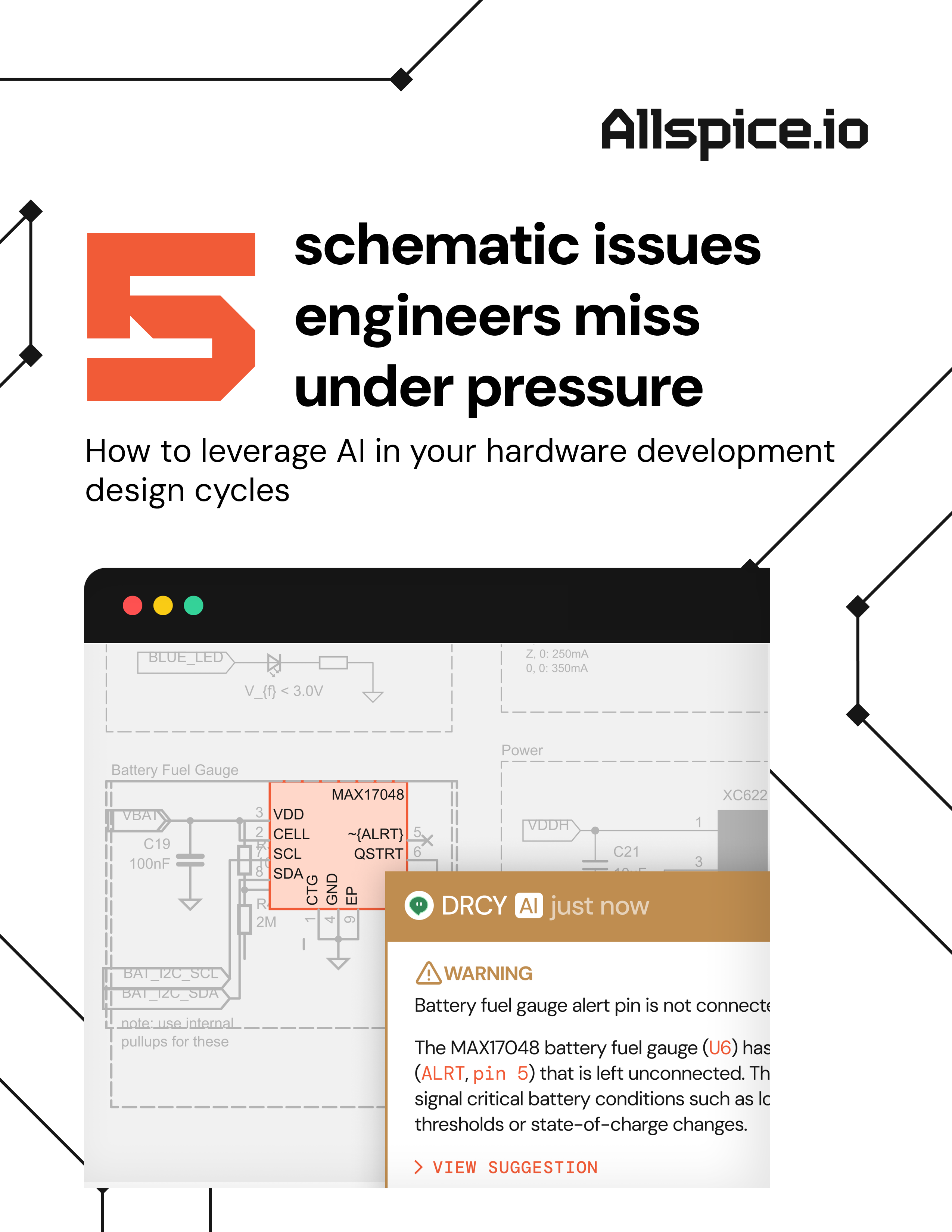
5 schematic issues engineers miss under pressure
Smarter hardware, fewer re-spins.
Design reviews do not fail because engineers stop caring. They fail because schedules tighten, designs grow more complex, and the small issues that matter most get buried in the noise. This guide looks at five schematic issues engineering teams often miss under schedule pressure, why they slip through manual review, and how AI-assisted review can help surface them earlier for engineer validation.
Chapters
Read it online, one chapter at a time.
Board respins cost 4–6 weeks and up to $100K each. Learn how AI design review is following the path of CAD and PLM to cut respins and speed hardware launches.
Schematic reviews slip under schedule pressure, not from lack of care. Learn why ordinary mistakes get missed and how AI-assisted review surfaces them earlier.
See how AI catches wrong footprints, cleans up BOMs, builds power tables, and maps hardware to firmware, so engineers spend less time on manual reviews.
Pin-to-net mismatches look correct on the page, so they slip past manual review. See how DRCY caught a swapped JTAG pair and a miswired USB interface early.
Learn how to roll out AI in hardware engineering: pick high-impact use cases, start with low-risk checks, keep humans in the loop, and prove ROI in 90 days.
Power and grounding errors hide across pages and familiar patterns. See how DRCY caught a reversed TVS diode and showed the datasheet evidence behind the fix.
Learn why general AI struggles with ECAD data, and how Allspice parses designs into structured data so DRCY can run datasheet-aware reviews in pull requests.
Interface details can look right and still be wrong. See how DRCY caught an LVDS termination on the wrong end by comparing it with the rest of the design.
What’s next for AI in hardware design: project templates, ECAD-trained models, automation-first workflows, and direct links to simulation and CM systems.
Missing part numbers and conflicting fields slow procurement and builds. See how AI review catches attribute gaps and values that don’t match design intent.
From slide rules to CAD to PLM, every computational leap reshaped engineering. AI is next, and it’s moving faster, making standing still the riskiest choice.
Small revision edits can carry big electrical risk. See how DRCY caught a MOSFET drain moved onto the wrong net, which would short the fan rail to ground.
See how DRCY fits real hardware workflows, plus best practices for AI-assisted review: complete designs, clear notes, meaningful net names, and grouped parts.
About the author