Bringing AI into hardware design reviews

Valentina Ratner
| Co-Founder & CEO
| Co-Founder & CTO

,

Kyle Dumont
| Co-Founder & CTO
| Co-Founder & CEO
January 17, 2026

Where hardware teams are today

Despite working on some of the most sophisticated technology in the world, many hardware engineers still rely on spreadsheets, tribal knowledge, and sometimes quite literally pen, paper, and a highlighter.

Delivering new hardware products on schedule often comes down to finding a needle in a haystack you don’t even know you’re looking for. The spec buried deep in a 900-page datasheet.

We know, because we’ve been there.

That's why, from day one, we’ve set out to automate the repeatable parts of hardware design: the well-defined, rules-based tasks that make sure nothing gets missed and everything lines up. That’s the kind of work technology is well suited for.

Introducing DRCY

Engineers shine in system-level design, informed judgment, and creative problem solving. In an ideal workflow, they spend their time on the decisions that shape the product, while technology handles the rest.

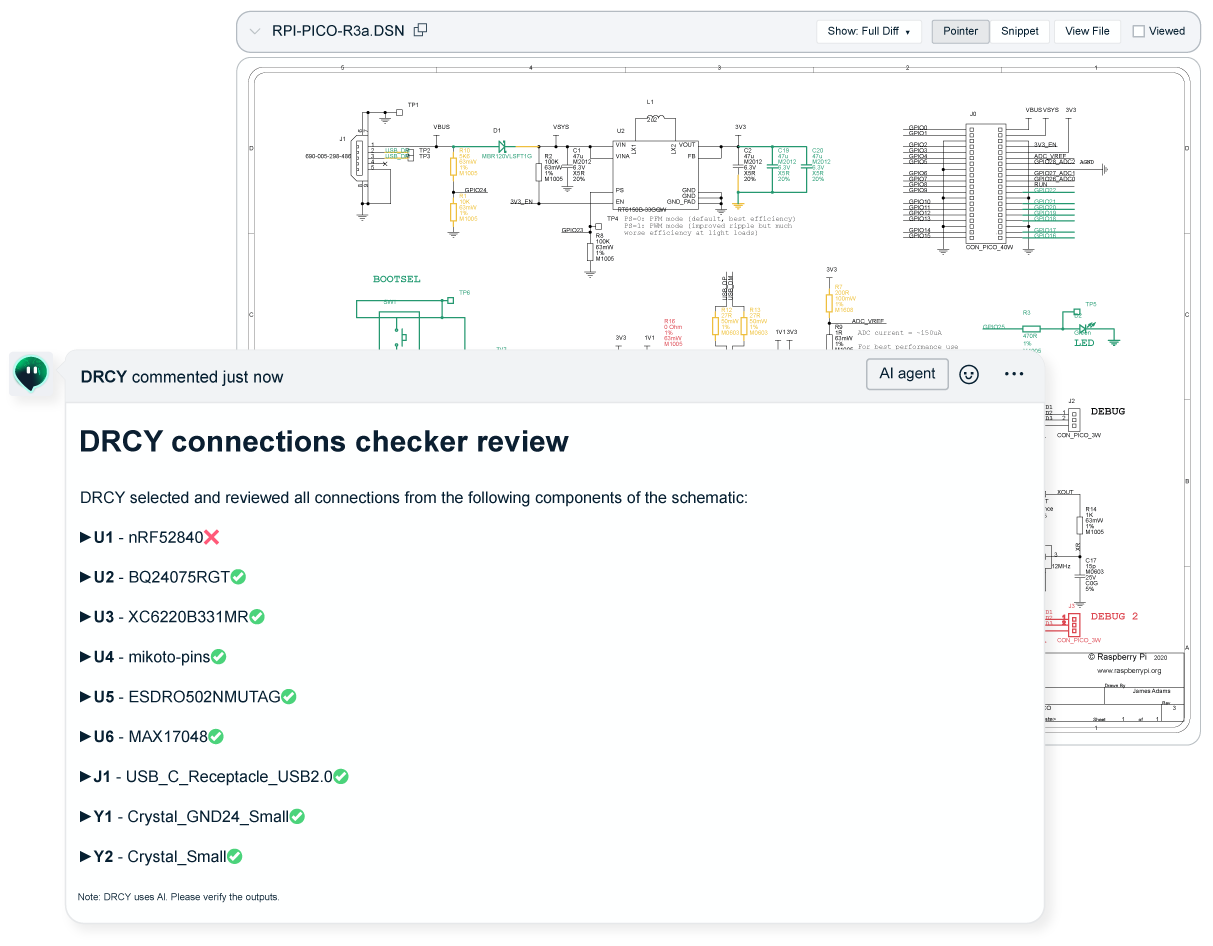
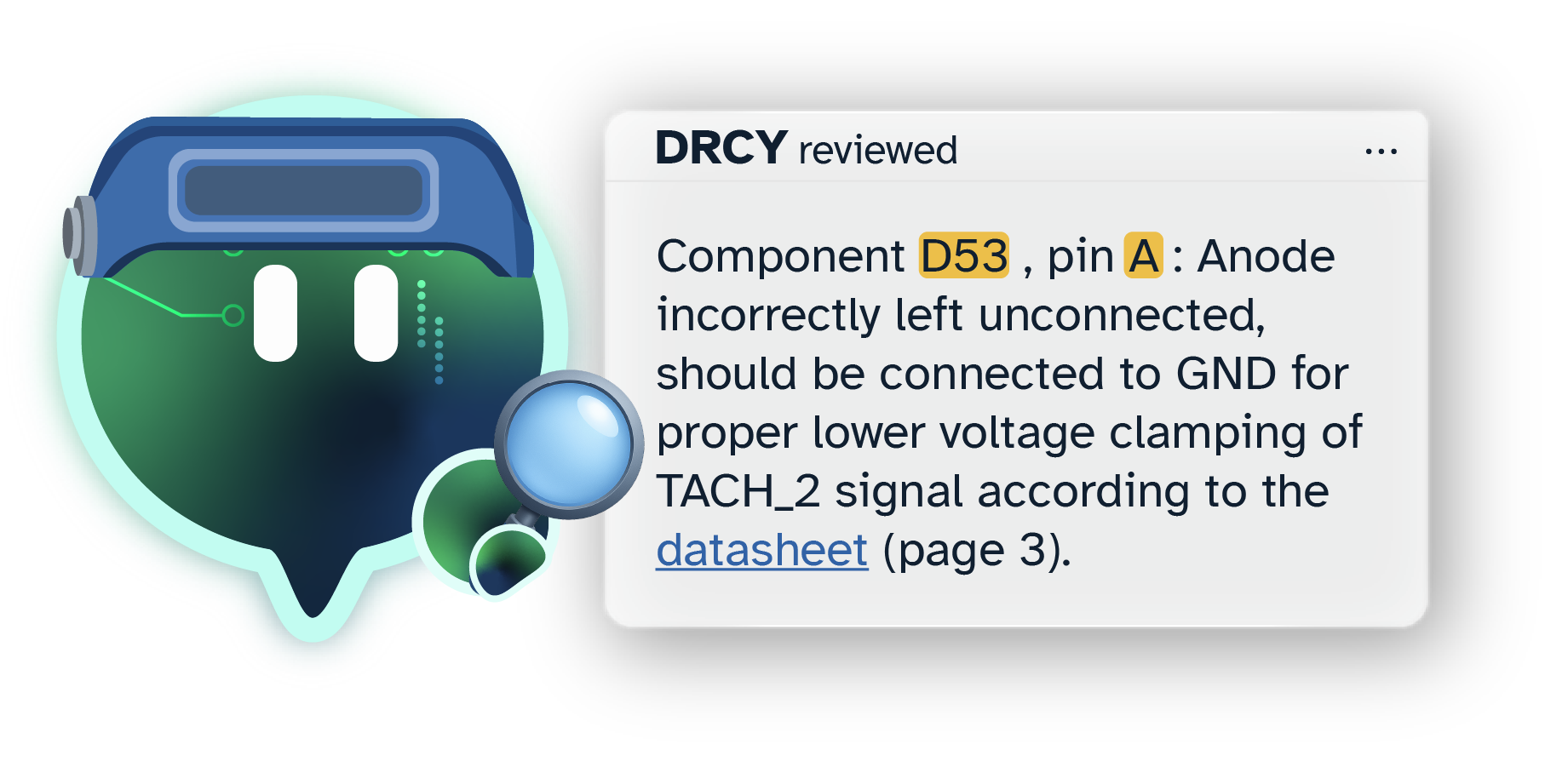
This is where DRCY comes in. DRCY is an AI-powered agent built specifically for hardware design reviews. It parses datasheets at scale and runs first-pass checks for compatibility and fundamental design issues, surfacing potential risks and pointing reviewers to where their attention matters most. Issues surface early, during reviews, when fixes are still fast and contained.
How DRCY reasons

DRCY combines foundational engineering knowledge with dynamically gathered context at runtime, rather than training on customer designs.

Four key ingredients power DRCY:

Designs. Schematics, PCBs, and libraries converted in AllSpice into a text-based representation AI can interpret accurately, avoiding the hallucinations introduced by PDFs and image OCR from general-purpose AI tools.

Organizational context. Prior reviews, comments, documentations, lessons learned, and design guidelines in AllSpice inform how DRCY evaluates new changes.

Datasheets. DRCY fetches and parses component datasheets and reference drawings, including proprietary documents you choose to provide.

AllSpice knowledge base. A continuously improving knowledge layer guides DRCY on best practices for electronics design and review.
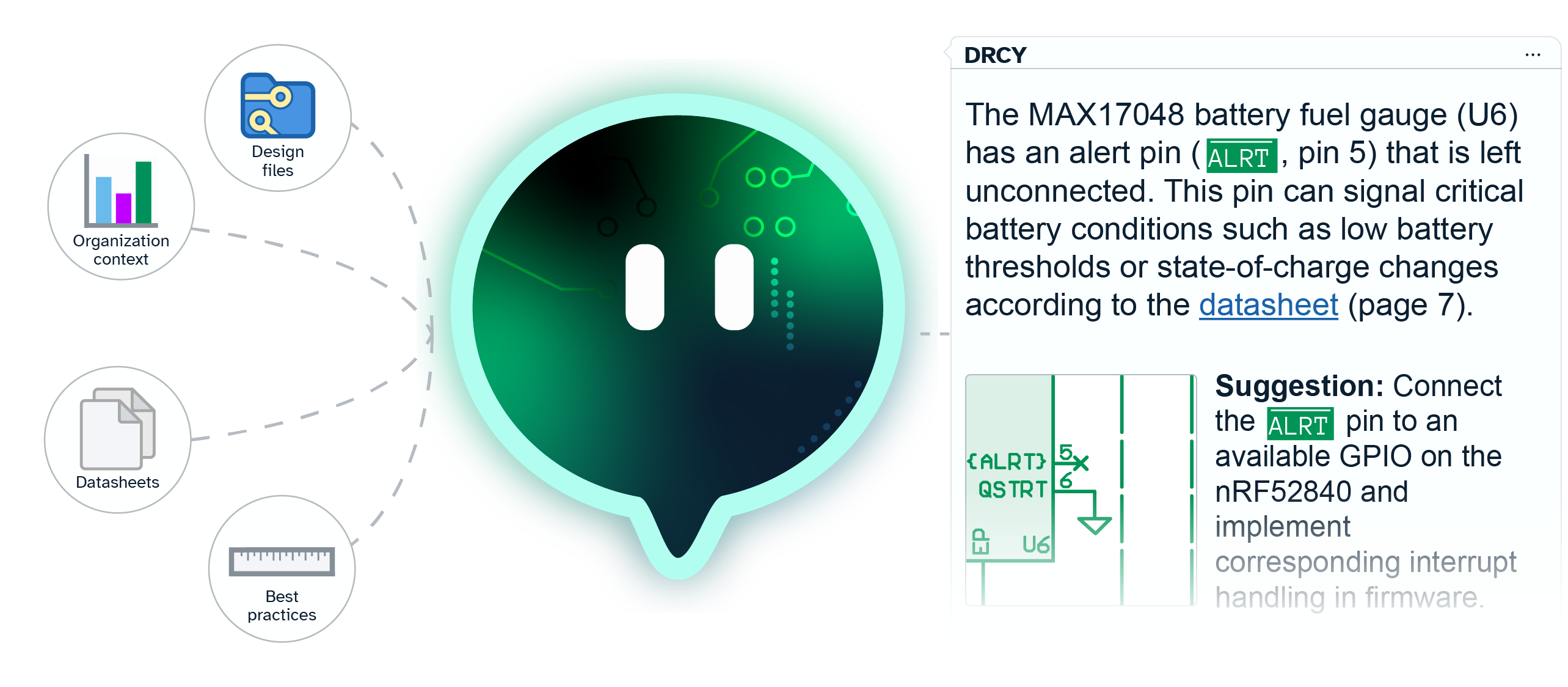
Green floating orb with Design files, Organization context, Datasheets, and Best practices being taken as input and a popup explaining MAX17048 battery fuel gauge alert pin alert and suggestion to connect it to GPIO as output.

What DRCY looks for

With access to designs, datasheets, and organizational context, DRCY handles repeatable, first-pass checks at scale. It validates documented constraints, cross-references components, and surfaces potential issues early, directly inside existing workflows.

In practice, DRCY looks for common but costly design issues, including:

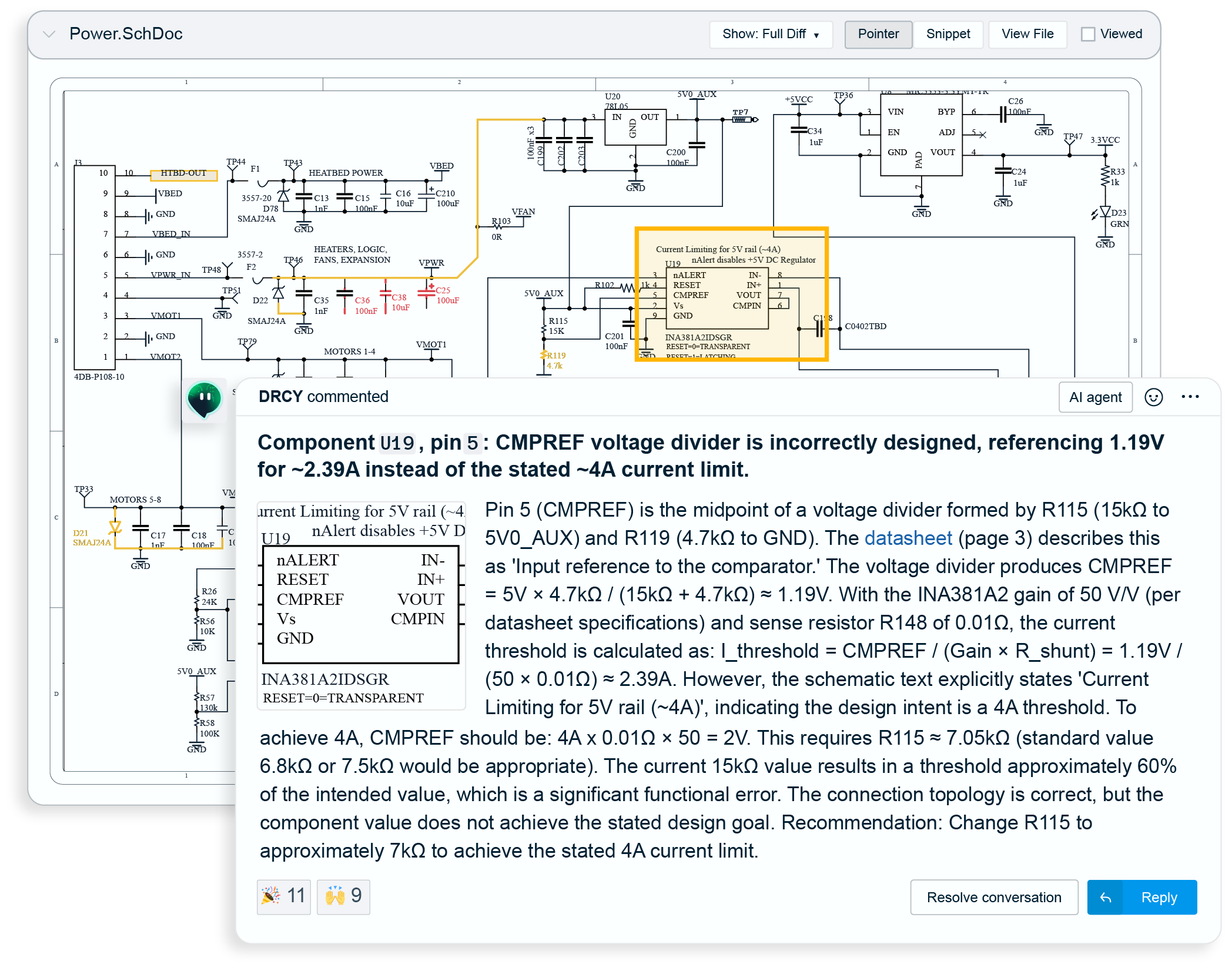
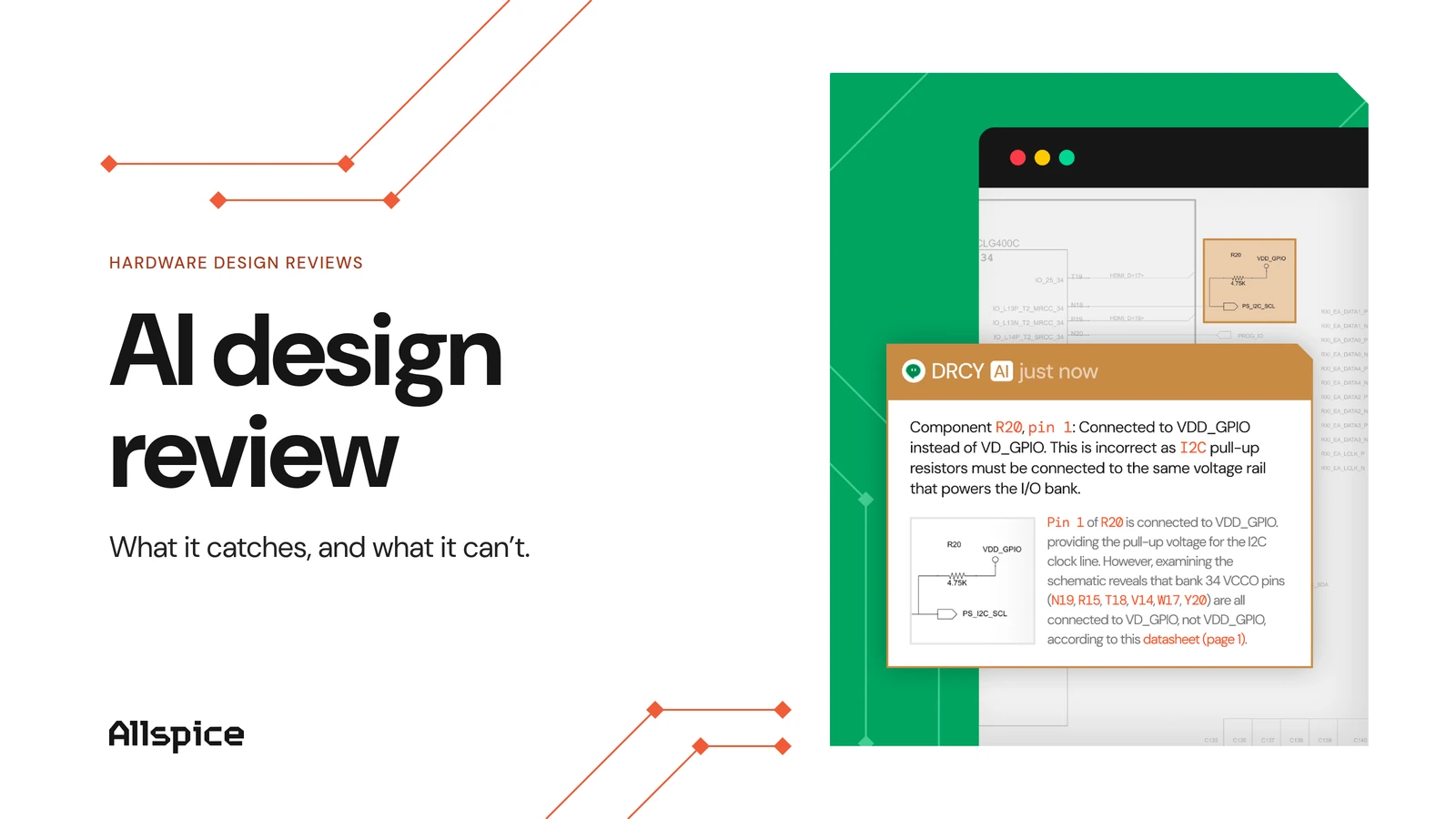
  • Incorrect voltage references for IC pins
  • Pins operating outside specified voltage or current limits
  • Swapped signals such as TX/RX, SDA/SCL, or USB differential pairs
  • Incorrect component packages
  • Reverse-polarity passive components
  • Mismatched voltage domains or insufficient pin drive strength
  • Reset circuitry issues
  • And more

Consider a common scenario. A contract manufacturer notifies your team that a component is end-of-life. To keep production moving, you need a replacement quickly. The team selects a substitute, but the substitute component has different reference voltage on one of the pins, completely breaking compatibility.

DRCY cross-references the datasheet and flags the issue for engineering review before the design moves forward. No re-spins. No production delays. No late-stage surprises.

This is the broader shift DRCY enables. Instead of reacting to errors after designs are sent to production, teams gain continuous, lightweight insight from the earliest stages of the design process.

Keeping engineers in the loop

DRCY is designed to support engineering judgment, not replace it. It surfaces risks, flags inconsistencies, and points directly to the source documentation behind each finding.

Engineers have clear visibility into why an issue was raised and the data it’s based on. Every finding is traceable, grounded in datasheets, specs, and reference designs.

Feedback appears directly in the design, with full context, so resolving issues is straightforward. Engineers stay in control, with the confidence that comes from AI that shows its work.

Bringing AI into production workflows

Today, AllSpice supports thousands of engineers across Fortune 50 companies, hyperscalers, and some of the most innovative teams in the world.

With DRCY, teams can change designs with confidence and make the RIGHT choice, not just the safe bet. It reduces uncertainty without slowing momentum, raises the quality bar without increasing headcount, and gives engineers the freedom to innovate.

We believe the future of hardware belongs to teams that stay focused on what really matters: design excellence, development speed, and advancing frontier technology.

If you’re designing hardware that pushes limits, we’d love to build alongside you.

- Valentina & Kyle

Table of contents

Newsletter

Be part of our hardware community for occasional engineering resources, guides, and events.
Headshot of a team member

Valentina Ratner

Co-Founder & CEO

At heart, I’m an engineer. I love building real world things and improving the way we build them. Early in my career, I watched capable teams build complex systems using archaic workflows that had not really evolved. AllSpice.io started as an effort to change that and bring modern software practices, and now AI, into hardware development. These days, I don’t build products hands-on anymore, but I get to see them come to live through the teams we support. Originally from Argentina, I moved to Boston for school and earned a B.S. in Mechanical Engineering from Boston University followed by an M.S. in Engineering with a focus on Computer Science and an MBA from Harvard. I now live in San Francisco with my husband, young son, and very sassy miniature schnauzer.

Headshot of a team member

Kyle Dumont

Co-Founder & CTO

I've always been obsessed with building, innovating, and finding novel solutions for emerging technologies. Since early in my career, I've loved the synthesis between physical hardware and digital integration electrical engineering offered, and spent many years taking hardware products from concept to mass-manufacturing. I started AllSpice.io to ensure hardware engineers have all of the data they need to make impactful decisions at their fingertips. I live in the Boston area, and hold a BS in Electrical Engineering from Northeastern University, a MS in Engineering with a focus on Computer Engineering and Machine Learning and an MBA from Harvard, and 5 patents in hardware system integration and sensor design.

Headshot of a team member

Valentina Ratner

Co-Founder & CEO

At heart, I’m an engineer. I love building real world things and improving the way we build them. Early in my career at Amazon, I watched capable teams build complex systems using archaic workflows that had not really evolved. AllSpice.io started as an effort to change that and bring modern software practices, and now AI, into hardware development. These days, I don’t build products hands-on anymore, but I get to see them come to live through the teams we support. Originally from Argentina, I moved to Boston for school and earned a B.S. in Mechanical Engineering from Boston University, an M.S. in Engineering (Computer Science), and an MBA from Harvard. I now live in San Francisco with my husband, young son, and very sassy miniature schnauzer.

Headshot of a team member

Kyle Dumont

Co-Founder & CTO

I've always been obsessed with building, innovating, and finding novel solutions for emerging technologies. Since early in my career, I've loved the synthesis between physical hardware and digital integration electrical engineering offered, and spent many years taking hardware products from concept to mass-manufacturing. I started AllSpice.io to ensure hardware engineers have all of the data they need to make impactful decisions at their fingertips. I live in the Boston area, and hold a BS in Electrical Engineering from Northeastern University, a MS in Engineering with a focus on Computer Engineering and Machine Learning and an MBA from Harvard, and 5 patents in hardware system integration and sensor design.

FAQs

Quick answers to common questions about this topic.

What is AI in hardware design reviews?

AI in hardware design reviews refers to using automated tools to analyze schematics and components against datasheets, constraints, and best practices to identify potential issues before human review.

How does AI improve hardware design reviews?

AI improves design reviews by catching common errors early, reducing manual checks, increasing consistency across revisions, and allowing engineers to focus on system-level decisions.

What types of issues can AI detect in hardware designs?

AI can detect issues such as incorrect voltage references, swapped signals, incompatible components, mismatched voltage domains, and violations of datasheet constraints.

Does AI replace engineers in hardware design reviews?

No. AI supports engineers by surfacing potential issues and providing context, while engineers remain responsible for final decisions and validation.

How does DRCY use datasheets in design reviews?

DRCY parses and cross-references datasheets with schematic data to verify specifications, validate constraints, and identify inconsistencies in the design.

When in the workflow is AI design review used?

AI design review is used as a first-pass check during early design stages, helping teams identify issues before layout, manufacturing, or production.

Can AI prevent hardware design errors entirely?

No. AI helps reduce errors and surface risks early, but it does not guarantee a fully error-free design and should be used alongside human review.

Latest posts

Interviews, guides, and practical insights across AI for hardware, design reviews, DevOps, and modern engineering workflows.
post
5
min
Learn how AI-powered schematic design review catches hardware issues early. See real examples from our DRCY webinar and run it on your own design.
Read post
post
4
min
DRCY brings AI-assisted schematic reviews into AllSpice, analyzing native ECAD data securely, catching issues early, with no exports or tool switching
Read post
post
3
min
Learn how DRCY, AllSpice’s AI design review agent, helps hardware teams catch fundamental design issues early.
Read post
Banner with text 'AI for Hardware Development' and a man reading a book titled 'AI for Hardware Development' by AllSpice.io, highlighting AI in hardware design cycles.