What is a hardware development platform? Features electrical engineering teams should require
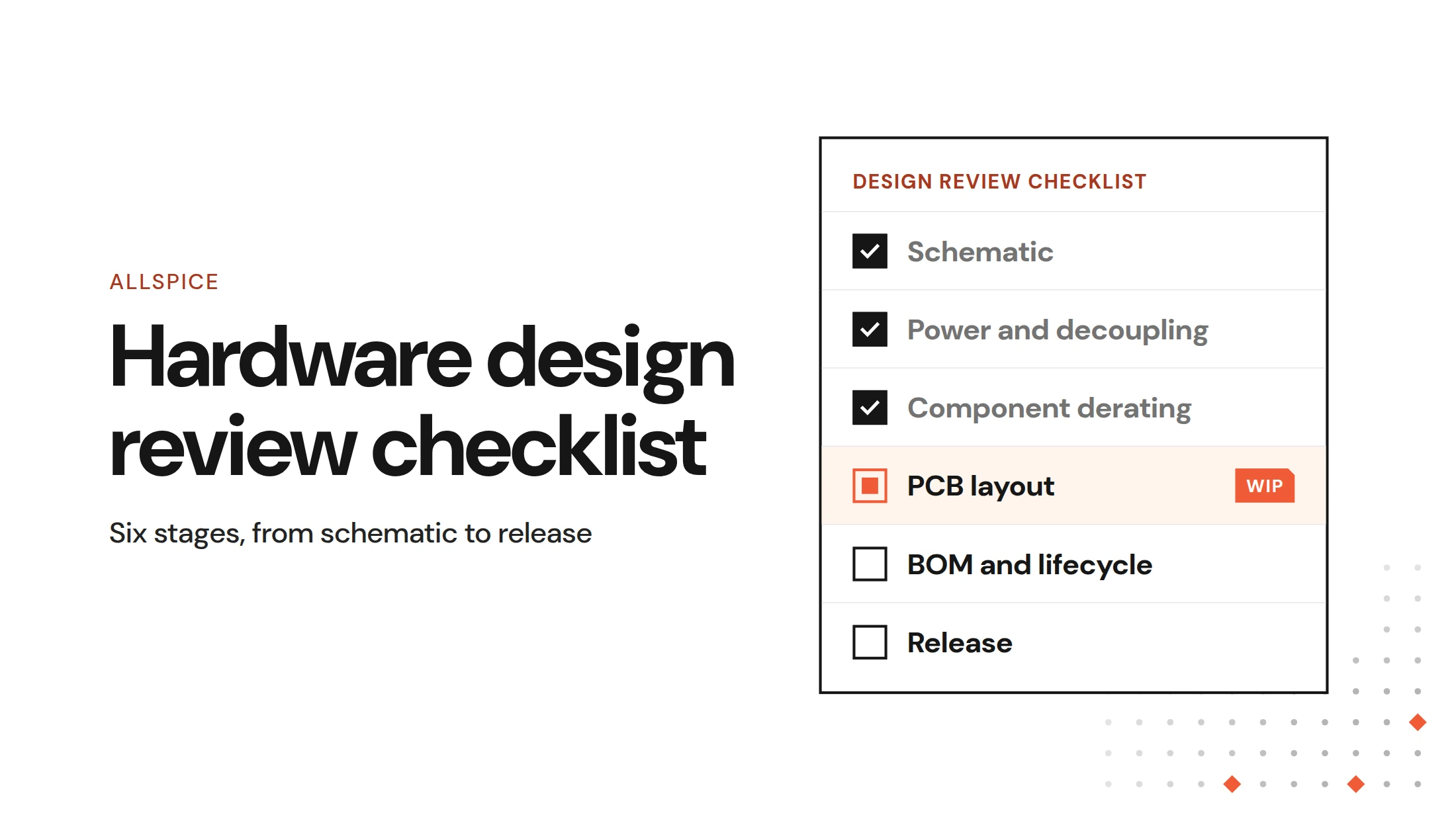
In many hardware organizations, design review still runs from an Excel checklist walked by hand against a PDF, with screenshots pasted into Jira. A hardware development platform moves that work onto the design itself, keeping files under revision control and carrying them through review to release. Allspice built its ECAD-agnostic revision control system for this, connecting to Altium Designer, OrCAD, Cadence and KiCad. This guide covers the six features to require and ends with a vendor checklist.
What is a hardware development platform?
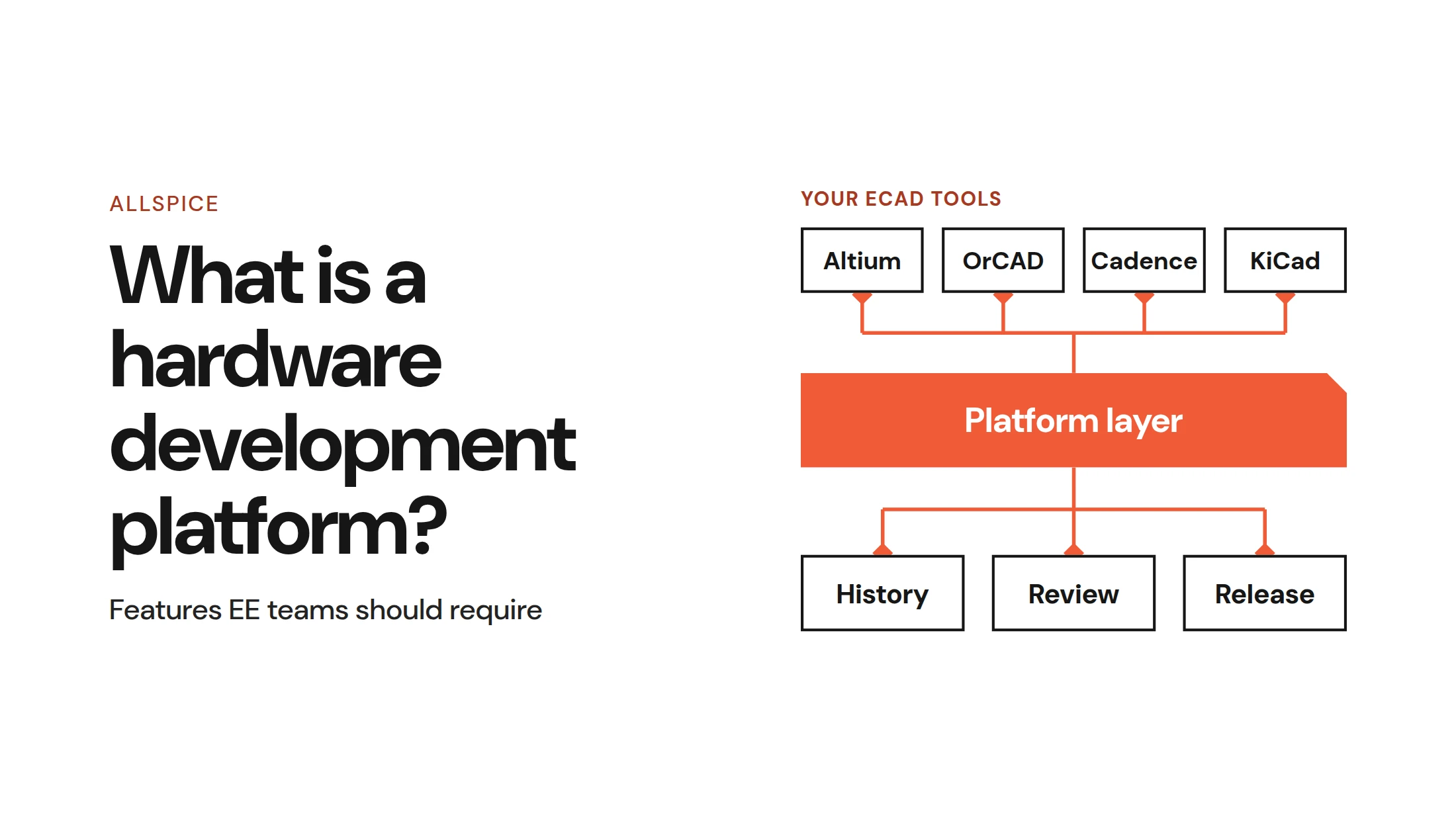
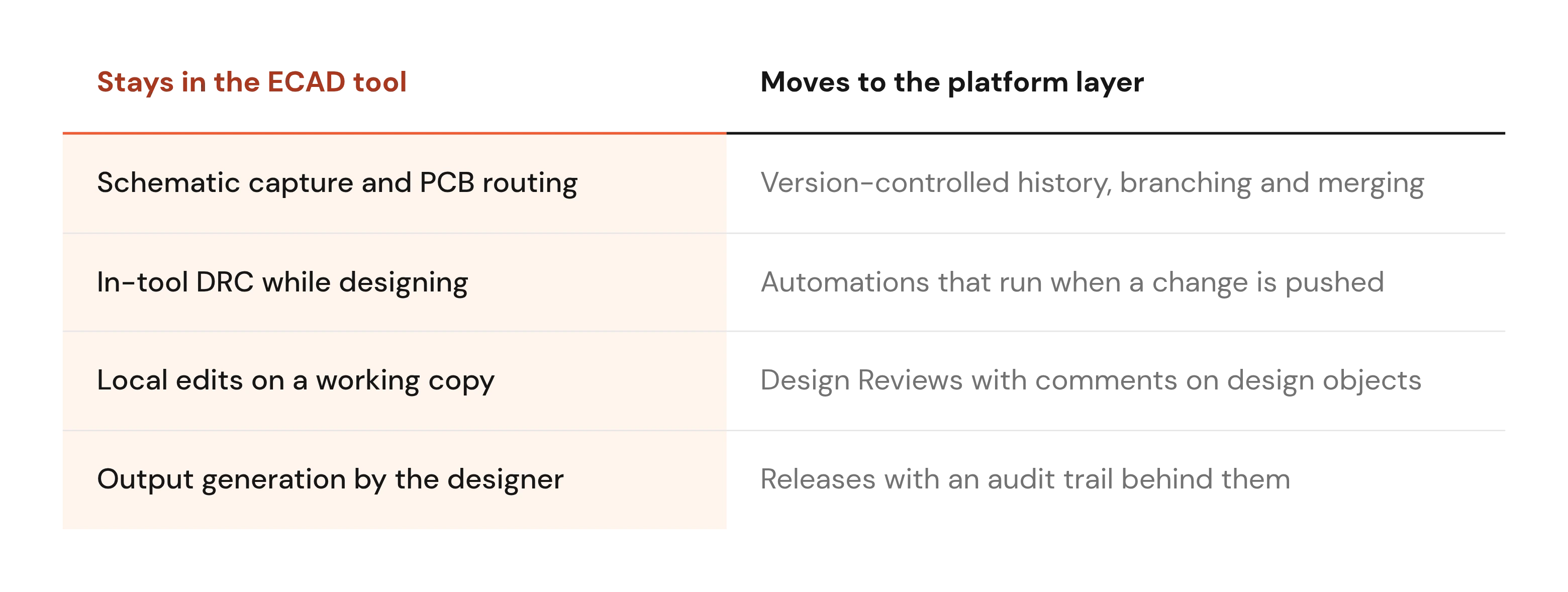
A hardware development platform is the layer that keeps electrical design data under revision control and moves it through design review to release. It works alongside ECAD tools, where engineers draw schematics and layouts, and is separate from embedded firmware toolchains such as IDEs and debuggers. Allspice is an ECAD-agnostic revision control system built for hardware that connects to Altium Designer, OrCAD, Cadence and KiCad.
Engineers keep designing in the ECAD tool they know. The platform holds the history and review record for every design file, whichever tool produced it. You can see how those pieces fit together in the Allspice platform overview.
The reason to care about this layer is the cost of finding problems late. In the NASA error cost escalation study, a 2004 analysis of aerospace systems, NASA estimated how fix costs grow by phase. Its ranges put the cost of fixing a requirements error during integration and test at 21–78 times the requirements-phase cost.
The same study found hardware fixes escalated less steeply than software fixes, but costs still rose by phase. On a board, the same logic applies: a misplaced capacitor caught in design review is an edit, and at bring-up it is a re-spin. A hardware development platform exists to pull review earlier and keep every change visible while it is still cheap to fix.
How a hardware collaboration platform helps distributed teams work together
In many hardware organizations, the design review is still a checklist in Excel, walked by hand against a PDF. Markups travel as screenshots pasted into Jira or PowerPoint, and the actual decisions end up in email threads. Six months later, nobody can say why R148 changed value or who signed off on it.
A hardware collaboration platform replaces that with one source of truth on the design itself. Engineers push native ECAD files and comment directly on the object in question, such as U11A or a net on the 3.3 V rail. The decision stays attached to the design, where the next reviewer will find it.
Allspice handles this with visual diff and design reviews on native files, so a reviewer in another office sees the same objects and comments. That matters because engineering work is less tied to one room. In the US Bureau of Labor Statistics BLS engineering telework data, 39.4% of architecture and engineering workers held jobs where telework was routinely allowed in 2025.
That figure describes job-level permission, so read it as context. Any team with even one remote reviewer needs a review record that holds up without a conference room. One hardware engineering customer described the core value plainly: "Even without the AI, there seems to be value, just from a revision control perspective."
Core features to require
Most of what a hardware development platform should do maps to configuration management, a discipline hardware programs already practice. ISO's ISO 10007 configuration management guidelines give guidance on configuration management within an organization, and ISO 10007:2017 sets no certifiable requirements. The six features below are the parts of configuration management a platform can support, such as change control, history and release.
For each feature, you get what it is, why it matters, how Allspice handles it and a question to put to every vendor. Allspice covers all six.
ECAD-agnostic version control for schematic and PCB files
Version control for hardware means every change to a schematic or PCB file is a commit with an author and a message. Branching lets an engineer try a layout change in isolation, and merging brings it back once it has been reviewed. The commit history becomes the answer to "what changed between rev B and rev C?"
This matters most in mixed-tool organizations. An acquired team may run OrCAD while the main group runs Altium Designer. A platform that only accepts exports ends up versioning the exports, and that history no longer matches what engineers edit.
Allspice keeps a full version-controlled history of native ECAD source files, with branching and merging, across Altium Designer, OrCAD, Cadence and KiCad. Our primer on revision control concepts for hardware covers how commits and branches map to hardware projects.
What to ask vendors: Which native ECAD formats can we push without exporting first? Ask whether the history tracks the source file itself.
Visual diff and design review
A text diff of a binary ECAD file tells a reviewer nothing useful. Visual diff renders two revisions and shows what moved, and object-level diff goes further by comparing the components and nets themselves. That difference decides whether a reviewer can trust the diff or has to eyeball two PDFs side by side.
Allspice diffs schematics, PCB layouts and BOMs at the object level. New objects show in green, deleted objects in red, and objects with an underlying change in yellow. Attribute-level changes count, so a swapped part number on R148 gets flagged even when the symbol has not moved.
Design Reviews are Allspice's name for a pull request. Reviewers comment on individual design objects and work through checklists inside the review, so the Excel checklist and the PDF markups live in one place.
What to ask vendors: Is your diff object-level, or an image overlay of two exported files? Ask them to show an attribute change, such as a swapped part number, on your own design.
Release and approval workflows
A release is the frozen, approved revision that manufacturing builds from. If you cannot trace a release back to its review and approvers, you cannot answer an auditor or a field failure investigation with confidence. Release control is where change control and status accounting meet.
In Allspice, teams cut Releases from the version-controlled history, and role-based permissions set who can do what. Compliance-ready audit trails keep the record of changes and reviews behind each release. Our guide to managing hardware releases walks through structuring revisions and release packages.
What to ask vendors: Can a release be traced back to its design review and approvers? Ask to see that trace on a past release.
CI-style automation checks
In software, continuous integration runs tests on every commit. The hardware equivalent runs rules-based checks whenever a design changes, before a human reviewer spends time on it. Engineers then spend review time on system-level judgment instead of checking part numbers by hand.
Allspice Automations are CI/CD workflows for hardware, and automated BOM validation is one example. Our post on Automations for electronics design explains how teams set them up.
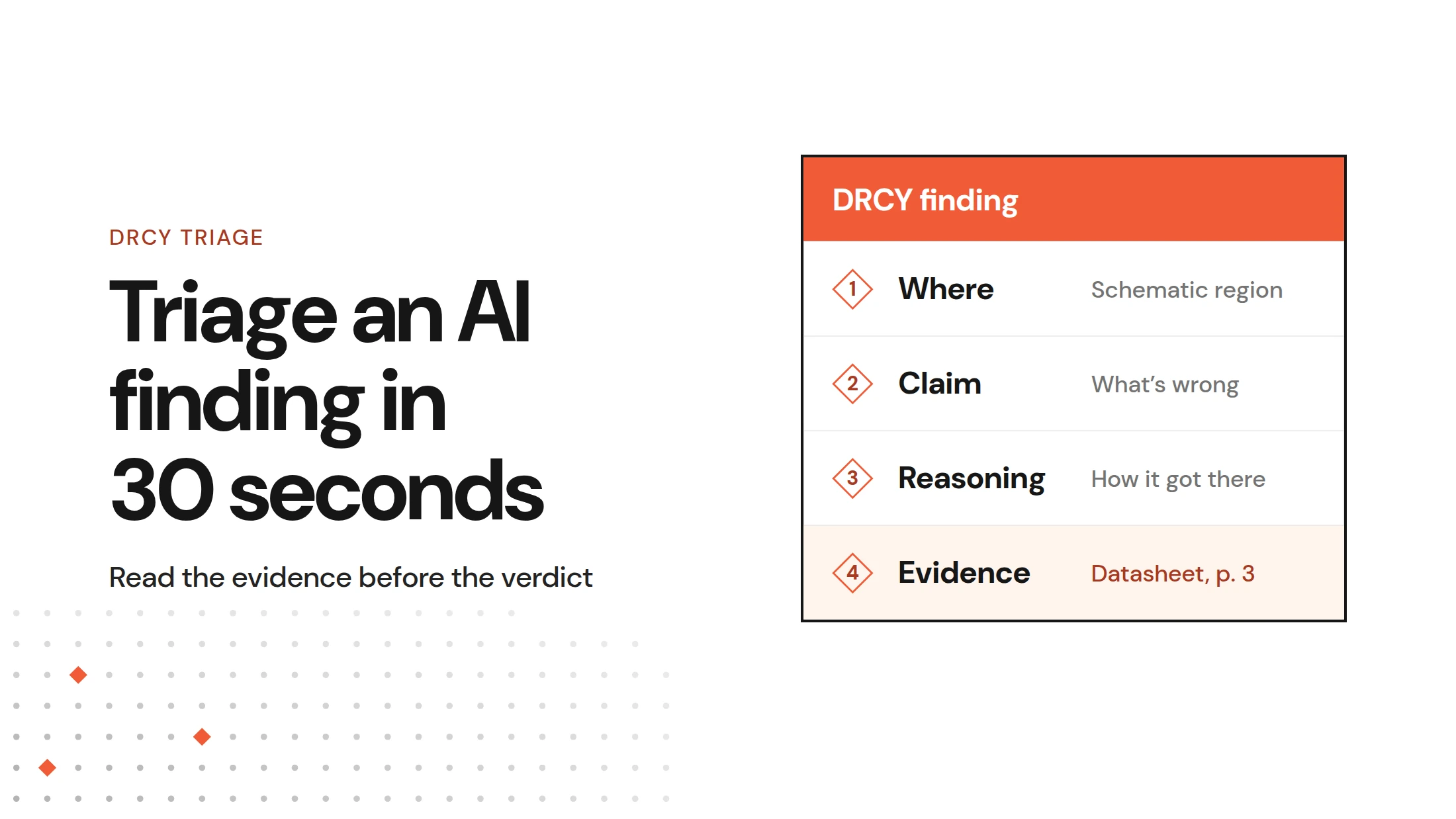
Allspice also offers DRCY, an AI first pass on schematics that reads datasheets and cites the datasheet page behind every finding. DRCY does not review layout.
What to ask vendors: What runs automatically before a change is approved? Ask who writes and maintains those checks.
BOM and production handoff
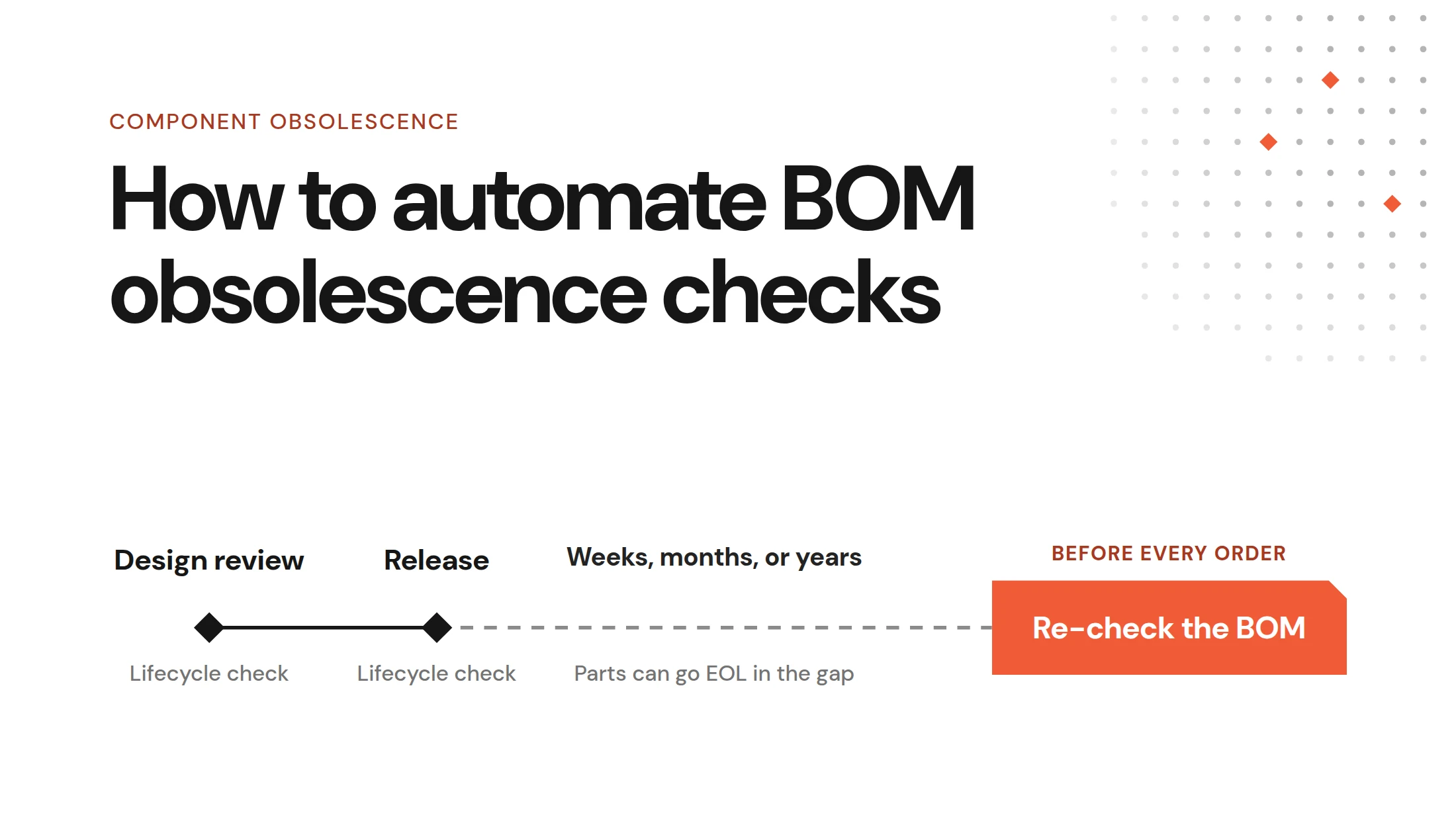
The BOM is where many late surprises surface. If a MAX17048 goes end-of-life between rev B and rev C, it can break compatibility for the next build. A BOM diff shows which lines changed between revisions, and automated checks can flag an end-of-life component before the order goes out.
Allspice diffs BOMs alongside schematics and layouts and runs automated BOM validation. Our walkthrough of automated BOM end-of-life checks shows one way to set this up.
The handoff package should come from a released revision, whatever format your manufacturer accepts. IPC's IPC-2581C standard scope defines a single XML file format that can carry the BOM, ECAD data, change history and approved vendor list.
What to ask vendors: What exactly does the manufacturer receive? Ask whether you can trace that package to a specific revision.
Access control and deployment options
Design data is core IP for any hardware organization. Role-based permissions limit who can change and approve a design, and audit trails show who did. Larger organizations also need a deployment model their IT team will sign off on.
Allspice provides role-based permissions and compliance-ready audit trails. On deployment, Allspice's answer is self-hosted, your own models, your own tokens. Bring your IT security questionnaire, and start with the Allspice security center.
What to ask vendors: Is there a self-hosted option? Ask whether they will complete your IT security questionnaire.
How a platform layer works alongside Altium, Cadence, OrCAD and KiCad
A platform layer does not ask anyone to change ECAD tools. Engineers keep capturing schematics and routing boards where they are fastest. The platform reads the native files and manages review and release history across all of them.
That matters most after acquisitions or reorganizations, when one product line runs Cadence and another runs KiCad. Without a shared layer, each group keeps its own review habits and its own release folder. With one, review and release follow the same process whichever tool drew the board.
Allspice connects to Altium Designer, OrCAD, Cadence and KiCad, plus Git platforms and project trackers. Teams keep their existing repositories and tickets while the design record moves into one place.
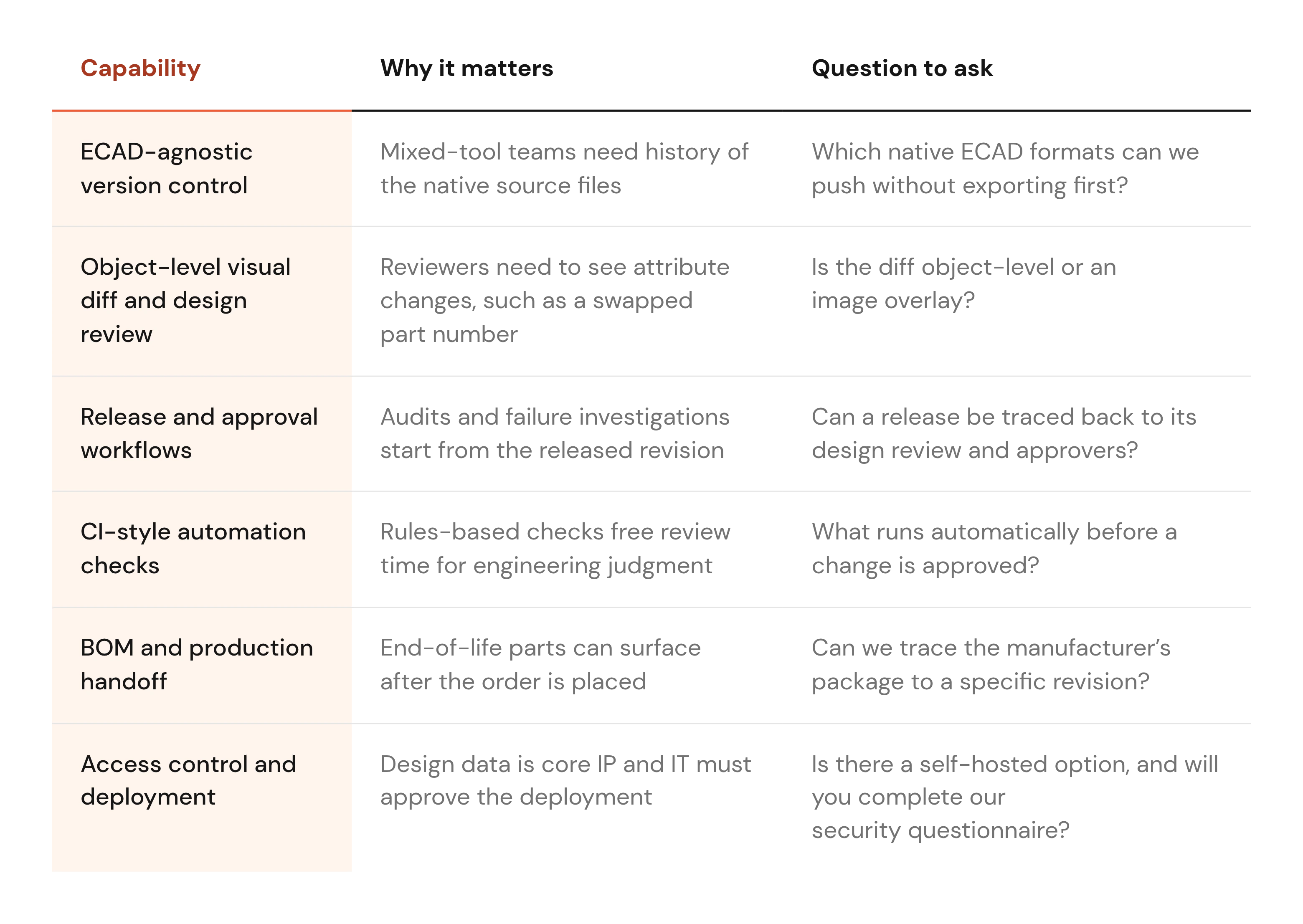
Hardware development platform evaluation checklist
Use this table in vendor conversations. Each row maps to one of the core features above.
FAQ
What features should a hardware development platform include for electrical engineering teams?
It should include ECAD-agnostic version control, object-level visual diff with design review, release workflows, CI-style automation, BOM handoff, and access control with deployment options. Allspice covers all six across Altium Designer, OrCAD, Cadence and KiCad.
What is a hardware collaboration platform and how does it help engineering teams work together?
A hardware collaboration platform gives every engineer one source of truth for design files, with comments and decisions attached to the design objects themselves. Allspice does this with visual diff and Design Reviews on native ECAD files, replacing Excel checklists and screenshots pasted into Jira or PowerPoint.
What is the best hardware design collaboration software for distributed engineering teams?
Look for native ECAD support, object-level diff, in-design commenting, audit trails and a self-hosted option. Allspice meets those criteria for established hardware organizations across Altium Designer, OrCAD, Cadence and KiCad, including Meta, AWS, Dell, Cisco, Bose, Molex and Tools for Humanity.
Is a hardware development platform the same as an ECAD tool?
An ECAD tool is where engineers create schematics and layouts. A hardware development platform such as Allspice sits alongside it, managing revision control and design review through to release.